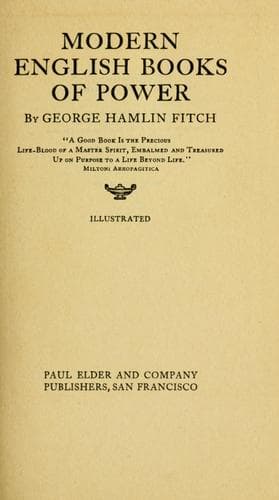
English literature -- 19th century -- History and criticism
For years Carlyle failed to make enough to support himself and his
wife, yet he refused a large income, offered by the LONDON TIMES for
editorial work, on the ground that he could not write to order nor
bend his opinions to those of others. He put behind him the
temptation to take advantage of great fame when it suddenly came to
him. When publishers were eager for his work he spent the same time in
preparing his books as when he was poor and unsought. He labored at
the smallest task to give the best that was in him; he wrote much of
his work in his heart's blood. Hence it is that through all of his
books, but especially through _Past and Present_ and _Heroes and Hero
Worship_, one feels the strong beat of the heart of this great man,
who yearned to make others follow the spiritual life that he had found
so full of strength and comfort.
Carlyle's life was largely one of work and self-denial. He was born of
poor parents at the little village of Ecclefechan, in Dumfriesshire,
Scotland. His father, though an uneducated stone-mason, was a man of
great mental force and originality, while his mother was a woman of
fine imagination, with a large gift of story telling. The boy received
the groundwork of a good education and then walked eighty miles to
Edinburgh University. Born in 1795, Carlyle went to Edinburgh in 1809.
His painful economy at college laid the foundation of the dyspepsia
which troubled him all his days, hampered his work and made him take a
gloomy view of life. At Edinburgh he made a specialty of mathematics
and German. He remained at the university five years.
The next fifteen years were spent in tutoring, hack writing for the
publishers and translation from the German. His first remunerative
work was the translation of Goethe's _Wilhelm Meister_, a version
which still remains the best in English. After his marriage to Jane
Welsh he was driven by poverty to take refuge on his wife's lonely
farm at Craigenputtock, where he did much reading and wrote the early
essays which contain some of his best work. The EDINBURGH REVIEW and
FRASER'S were opened to him.
Finally, in 1833, when he was nearly forty years old, he made his
first literary hit with _Sartor Resartus_ which called out a storm of
caustic criticism. The Germanic style, the elephantine humor, the
strange conceits and the sledge-hammer blows at all which the smug
English public regarded with reverence--all these features aroused
irritation. Four years later came _The French Revolution_, which
established Carlyle's fame as one of the greatest of English writers.
From this time on he was freed from the fear of poverty, but it was
only in his last years, when he needed little, that he enjoyed an
income worthy of his labors.
Public-domain text, read in full here on John Shaqi.
Reviews
Reviews
No reviews yet
Be the first to share your thoughts on this work.
Join the Discussion
Join the discussion
Sign in to leave a comment or review.
Sign InorCreate an account