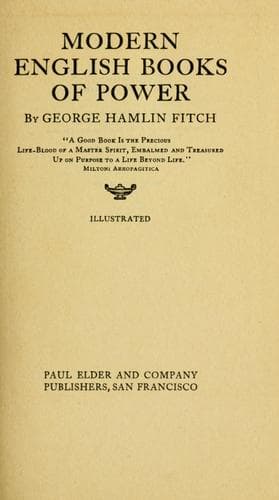
English literature -- 19th century -- History and criticism
Carlyle's great books, beside those I have mentioned, are the lives of
_Cromwell_ and of _Frederick the Great_. These are too long for
general reading, but a single volume condensation of the _Frederick_
gives a good idea of Carlyle's method of combining biography and
history. Carlyle outlived all his contemporaries--a lonely old man,
full of bitter remorse over imaginary neglect of his wife, and full
also of despair over the democratic tendencies of the age, which he
regarded as the outward signs of national degeneracy.
Carlyle's fame was clouded thirty years ago by the unwise publication
of reminiscences and letters which he never intended for print. Froude
was chosen as his biographer. One of the great masters of English,
Froude was a bachelor who idealized Mrs. Carlyle and who regarded as
the simple truth an old man's bitter regrets over opportunities
neglected to make his wife happier. Everyone who has studied Carlyle's
life knows that he was dogmatic, dyspeptic, irritable, and given to
sharp speech even against those he loved the best. But over against
these failings must be placed his tenderness, his unfaltering
affection, his self-denial, his tremendous labors, his small rewards.
When separated from his wife Carlyle wrote her letters that are like
those of a young lover, an infinite tenderness in every line. One of
her great crosses was the belief that her husband was in love with the
brilliant Lady Ashburton. Her jealousy was absurd, as this great lady
invited Carlyle to her dinners because he was the most brilliant
talker in all England, and he accepted because the opportunity to
indulge in monologue to appreciative hearers was a keener pleasure to
him than to write eloquent warnings to his day and generation.
Froude's unhappy book, with a small library of commentary that it
called forth, is practically forgotten, but Carlyle's fame and his
books endure because they are real and not founded on illusion.
Carlyle opens a new world to the college student or the ambitious
youth who may be gaining an education by his own efforts. He sounds a
note that is found in no other author of our time. Doubtless some of
this attraction is due to his singular style, formed on a long study
of the German, but most of it is due to the tremendous earnestness of
the man, which lays hold of the young reader. Never shall I forget
when in college preparatory days I devoured _Past and Present_ and was
stirred to extra effort by its trumpet calls that work is worship and
that the night soon cometh when no man can work.
Public-domain text, read in full here on John Shaqi.
Reviews
Reviews
No reviews yet
Be the first to share your thoughts on this work.
Join the Discussion
Join the discussion
Sign in to leave a comment or review.
Sign InorCreate an account