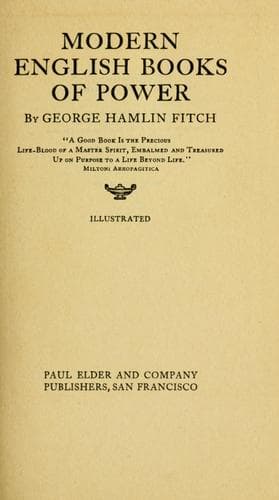
English literature -- 19th century -- History and criticism
His fine chapter on _Labor_ with its splendid version of the _Mason's
Song_ of Goethe has stimulated thousands to take up heavy burdens and
go on with the struggle for that culture of the mind and the soul
which is the more precious the harder the fight to secure it. I
remember copying in a commonplace book some of Carlyle's sonorous
passages that stir the blood of the young like a bugle call to arms.
Reading them over years after, I am glad to say that they still
appealed to me, for it seems to me that the saddest thing in this
world is to lose one's youthful enthusiasms. When you can keep these
fresh and strong, after years of contact with a selfish world, age
cannot touch you.
[Illustration: ARCHHOUSE, ECCLEFECHAN, DUMFRIESSHIRE THE
BIRTHPLACE OF THOMAS CARLYLE--FROM A PHOTOGRAPH IN THE POSSESSION
OF ALEXANDER CARLYLE, M.A. ON WHICH CARLYLE HAS WRITTEN A
MEMORANDUM TO SHOW IN WHICH ROOM HE WAS BORN]
In this appeal to all that is best and noblest in youth, Carlyle
stands unrivaled. He has far more heart, force and real warm blood
than Emerson, who saw just as clearly, but who could not make his
thought reach the reader. A course in Carlyle should be compulsory in
the freshman year at every college. If the lecturer were a man still
full of his early enthusiasms it could not fail to have rich results.
Take, for instance, those two chapters in _Past and Present_ that are
entitled "Happy" and "Labor." In a dozen pages are summed up all
Carlyle's creed. In these pages he declares that the only enduring
happiness is found in good, honest work, done with all a man's heart
and soul. And after caustic words on the modern craving for happiness
he ends a noble diatribe with these words, which are worth framing and
hanging on the wall, where they may be studied day by day:
Brief brawling Day, with its noisy phantasms, its poor
paper-crown's tinsel-gilt, is gone; and divine everlasting
Night, with her star-diadems, with her silences and her
veracities, is come! What hast thou done, and how? Happiness,
unhappiness; all that was but wages thou hadst; thou hast
spent all that, in sustaining thyself hitherward; not a coin
of it remains with thee; it is all spent, eaten; and now thy
work, where is thy work? Swift, out with it; let us see thy
work!
Public-domain text, read in full here on John Shaqi.
Reviews
Reviews
No reviews yet
Be the first to share your thoughts on this work.
Join the Discussion
Join the discussion
Sign in to leave a comment or review.
Sign InorCreate an account