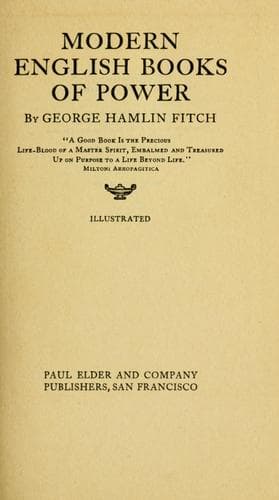
English literature -- 19th century -- History and criticism
It is idle to expect another Lamb in our strenuous modern life, so we
should make the most of this quaint Englishman of the early part of
the last century, who seemed to bring over into an artificial age all
the dewy freshness of fancy of the old Elizabethan worthies. Can
anything be more perfect in its pathos than his essay on "Dream
Children," the tender fancy of a bachelor whom hard fate robbed of the
domestic joys that would have made life beautiful for him? Can
anything be more full of fun than his "Dissertation on Roast Pig," or
his "Mrs. Battle's Opinion on Whist"? His style fitted his thought
like a glove; about it is the aroma of an earlier age when men and
women opened their hearts like children. Lamb lays a spell upon us
such as no other writer can work; he plays upon the strings of our
hearts, now surprising us into wholesome laughter, now melting us to
tears. You may know his essays by heart, but you can't define their
elusive charm.
Lamb had one of the saddest of lives, yet he remained sweet and
wholesome through trials that would have embittered a nature less fine
and noble. He came of poor people and he and his sister Mary inherited
from their mother a strain of mental unsoundness. Lamb spent seven
years in Christ's Hospital as a "Blue Coat" boy, and the chief result,
aside from the foundations of a good classical scholarship, was a
friendship for Coleridge which endured through life. From this school
he was forced to go into a clerkship in the South Sea house, but after
three years he secured a desk in the East India house, where he
remained for thirty years.
Four years later his first great sorrow fell upon Lamb. His sister
Mary suddenly developed insanity, attacked a maid servant, and when
the mother interfered the insane girl fatally wounded her with a
knife. In this crisis Lamb showed the fineness of his nature. Instead
of permitting poor Mary to be consigned to a public insane asylum, he
gave bonds that he would care for her, and he did care for her during
the remainder of her life. Although in love with a girl, he resolutely
put aside all thoughts of marriage and domestic happiness and devoted
himself to his unfortunate sister, who in her lucid periods repaid his
devotion with the tenderest affection.
Public-domain text, read in full here on John Shaqi.
Reviews
Reviews
No reviews yet
Be the first to share your thoughts on this work.
Join the Discussion
Join the discussion
Sign in to leave a comment or review.
Sign InorCreate an account