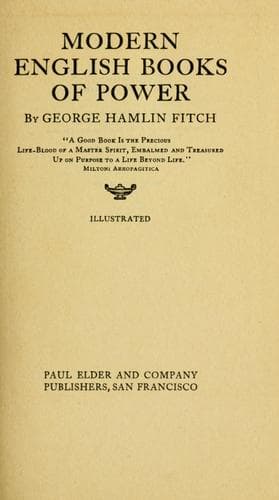
English literature -- 19th century -- History and criticism
Lamb's letters to Coleridge in those trying days are among the most
pathetic in the language. To Coleridge he turned for stimulus in his
reading and study, and he never failed to get help and comfort from
this great, ill-balanced man of genius. Later he began a
correspondence with Southey, in which he betrayed much humor and great
fancy. In his leisure he saturated his mind with the Elizabethan poets
and dramatists; practically he lived in the sixteenth century, for his
only real life was a student's dream life. He contributed to the
London newspapers, but his first published work to score any success
was his _Tales From Shakespeare_, in which his sister aided him. Then
followed _Poets Contemporary With Shakespeare_, selections with
critical comment, which at once gave Lamb rank among the best critics
of his time. He wrote, when the mood seized him, recollections of his
youth, essays and criticisms which he afterward issued in two volumes.
Twenty-five essays that he contributed to the LONDON MAGAZINE over the
signature of Elia were reprinted in a book, the _Essays of Elia_, and
established Lamb's reputation as one of the great masters of English.
Another volume of _Essays of Elia_ was published in 1833. In 1834 Lamb
sorrowed over the death of Coleridge, and in November of the same year
death came to him. Of all English critics Carlyle is the only one who
had hard words for Lamb, and the Sage of Chelsea probably wrote his
scornful comment because of some playful jest of Elia.
Charles Lamb's taste was for the writers of the Elizabethan age, and
even in his time he found that this taste had become old-fashioned. He
complained, when only twenty-one years old, in a letter to Coleridge,
that all his friends "read nothing but reviews and new books." His
letters, like his essays, reflect the reading of little-known books;
they show abundant traces of his loiterings in the byways of
literature.
Here there is space only to dwell on some of the best of the _Essays
of Elia_. In these we find the most pathetic deal with the sufferings
of children. Lamb himself had known loneliness and suffering and lack
of appreciation when a boy in the great Blue Coat School. Far more
vividly than Dickens he brings before us his neglected childhood and
all that it represented in lonely helplessness. Then he deals with
later things, with his love of old books, his passion for the play,
his delight in London and its various aspects, his joy in all strange
characters like the old benchers of the Inner Temple.
[Illustration: MARY AND CHARLES LAMB FROM THE PAINTING BY F.S.
CARY MADE IN 1834]
Public-domain text, read in full here on John Shaqi.
Reviews
Reviews
No reviews yet
Be the first to share your thoughts on this work.
Join the Discussion
Join the discussion
Sign in to leave a comment or review.
Sign InorCreate an account