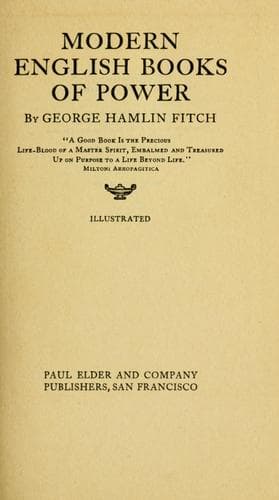
English literature -- 19th century -- History and criticism
The essay opens with that alluring picture of the South Sea house, and
is followed by the reminiscences of Christ's Hospital, where Lamb
was a schoolboy for seven years. These show one side of Lamb's
nature--the quaintly reminiscent. Another side is revealed in "Mrs.
Battle's Opinions on Whist," with its delicate irony and its playful
humor, while still another phase is seen in the exquisite phantasy of
"Dream Children," with its tender pathos and its revelation of a heart
that never knew the joys of domestic love and care. Yet close after
this beautiful reverie comes "A Dissertation On Roast Pig," in which
Lamb develops the theory that the Chinese first discovered the virtues
of roast suckling pig after a fire which destroyed the house of Ho-ti,
and that with the fatuousness of the race they regularly burned down
their houses to enjoy this succulent delicacy.
_The Last Essays of Elia_, a second series which Lamb brought out with
a curious preface "by a friend of the late Elia," do not differ from
the earlier series, save that they are shorter and are more devoted to
literary themes. Perfect in its pathos is "The Superannuated Man,"
while "The Child Angel" is a dream which appeals to the reader more
than any of the splendid dreams that De Quincey immortalized in his
florid prose. Lamb in these essays gives some wise counsel on books
and reading, urging with a whimsical earnestness the claims of the
good old books which had been his comfort in many dark hours. It is in
such confidences that we come very close to this man, so richly
endowed with all endearing qualities that the world will never forget
Elia and his exquisite essays.
DICKENS THE FOREMOST OF NOVELISTS
MORE WIDELY READ THAN ANY OTHER STORY TELLER--THE GREATEST OF
THE MODERN HUMORISTS APPEALS TO THE READERS OF ALL AGES AND
CLASSES.
Charles Dickens is the greatest English novelist since Scott, and he
and Scott, to my mind, are the greatest English writers after
Shakespeare. Many will dissent from this, but my reason for giving him
this foremost place among the modern writers is the range, the
variety, the dramatic power, the humor and the pathos of his work. He
was a great caricaturist rather than a great artist, but he was
supreme in his class, and his grotesque characters have enough in them
of human nature to make them accepted as real people.
Public-domain text, read in full here on John Shaqi.
Reviews
Reviews
No reviews yet
Be the first to share your thoughts on this work.
Join the Discussion
Join the discussion
Sign in to leave a comment or review.
Sign InorCreate an account