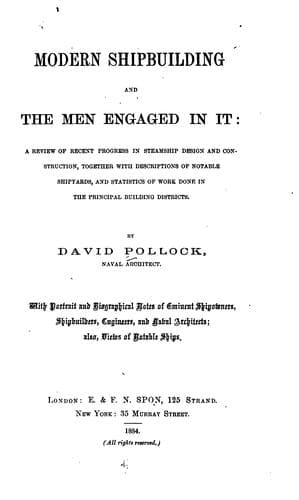
Modern shipbuilding and the men engaged in itPollock, David
History
Modern shipbuilding and the men engaged in it
Pollock, David
Shipbuilding -- Great Britain
The steel furnished by these different works, subjected as it
has been to systematic and severe tests continually applied, is
now possessed of the qualities of ductility, malleability, and
homogeneity, which render its employment in shipbuilding not only
permissible but highly desirable. Its good and reliable qualities
have been admitted by the Constructors of the Navy, the Officers of
the Board of Trade, of Lloyd’s, and of the Liverpool Registries, as
well as by all the most competent authorities. The experience of all
who have practical dealings with the material in the shipyard is
that it entirely satisfies—even more than iron—all the requirements
of easy manipulation. The confidence with which it can be relied on,
as to its certain and uniform qualities, places it on a much higher
level than the steel formerly manufactured; and its superiority over
the best wrought-iron as regards strength and ductility renders it a
highly preferable material.
While doubt exists, however, as to the adoption of steel for
shipbuilding being commercially advantageous; there must be hesitancy
on the part of shipowners and others concerned. Although, since its
introduction, mild steel has been greatly reduced in price, the
first cost of a steel ship is still somewhat over that of an iron
one, even after the reduction in weight of material is made, which
the superiority of steel permits of. It has been shown that, about
two years ago, a spar-decked steamer, of 4,000 tons gross, built in
steel, as against a similar vessel built in iron, entailed an excess
in cost of £3,570. The advantages, however, which accrue from the
change, both immediate and in the long run, make the gain clear and
considerable. Steel ships have been built with scantlings reduced
one-fourth or one-third, and in some early cases even _one-half_,
from what would have been considered requisite had iron been
employed. Some authorities, not unnaturally, questioned the wisdom
of accrediting steel with all the qualities which make such sweeping
reductions justifiable. Except in vessels for river or passenger
service, however, this is much in advance of the reductions obtained
in ordinary modern practice.
The reductions allowed in vessels built to Lloyd’s requirements—and
it cannot be urged that this society is too reckless in concessions
of this nature—are 20 per cent. in scantling, and 18 per cent. in
weight. As it is impossible to adjust the scantlings of material
to take the full advantage of these reductions, and further, as
allowance has to be made for extra weight due to the continued use
of iron in vessels of steel—for purposes not essential to structural
character—the average weight-saving effected in practice is about
13 to 14 per cent. This represents, in the finished vessel, a clear
increase of at least 13 per cent. in dead-weight carrying power. The
gain obtained in general practice has been otherwise stated on good
authority as 7 to 7½ per cent. of the gross tonnage.
Public-domain text, read in full here on John Shaqi.
Reviews
Reviews
No reviews yet
Be the first to share your thoughts on this work.
Join the Discussion
Join the discussion
Sign in to leave a comment or review.
Sign InorCreate an account