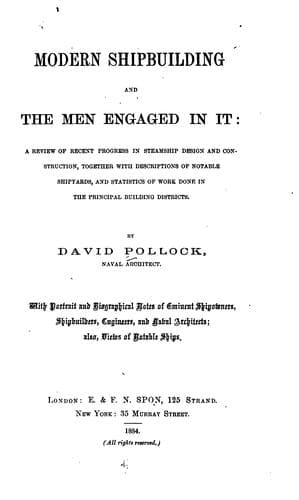
Modern shipbuilding and the men engaged in itPollock, David
History
Modern shipbuilding and the men engaged in it
Pollock, David
Shipbuilding -- Great Britain
Although the introduction of steel as a material for shipbuilding
dates at least as far back as 1860, its use has been but partial
or occasional until within very recent times. The uncertainty as
to quality, the frequent great disparity between pieces cut from
the same plate, and the special care needed in the manipulation,
prevented its general adoption. With the highly-improved “mild
steel,” however, first manufactured in France, and applied to
shipbuilding purposes there about nine years ago, and subsequently
introduced into this country, began the more extended adoption of
steel, which every day, or with every accession to experience, is
displacing iron.
The facts relating to the introduction into this country of mild
steel for shipbuilding purposes, may be briefly recounted. In the
latter end of 1874, Admiral Sir W. Houston Stewart, Controller of
the British Navy, and Mr N. Barnaby, Director of Naval Construction,
availed themselves of the opportunity to observe and study the use
of steel in the French dockyards of Lorient and Brest, where three
first-class armour-plated vessels were then being built of steel
throughout, supplied from the works at Creusot and Terrenoire. Mr
Barnaby, at the meetings of the Institution of Naval Architects in
March following, gave an account of his observations during this
visit, and pointed out clearly and precisely to the steel-makers of
Great Britain all the indispensable conditions which would have to be
met and satisfied by steel for shipbuilding, so that it could be used
with confidence in the construction of the largest vessels. Before
the end of 1875, the Landore-Siemens Company was enabled to fulfil
these conditions, and the Admiralty contracted with them to supply
the plates and angles necessary for the construction of two cruisers
of high speed—the _Iris_ and the _Mercury_. The material involved
in this contract was steel obtained by the Siemens-Martin process.
Shortly after this the Bolton Steel Company was in its turn able to
produce by the Bessemer process plates and angles, satisfying all
the requisite conditions. The Steel Company of Scotland, Butterly
Company, and other important works, also entered into the same
business, and operations are still going on in various parts of the
country connected with the formation of new works, and the perfecting
of other processes.
Public-domain text, read in full here on John Shaqi.
Reviews
Reviews
No reviews yet
Be the first to share your thoughts on this work.
Join the Discussion
Join the discussion
Sign in to leave a comment or review.
Sign InorCreate an account