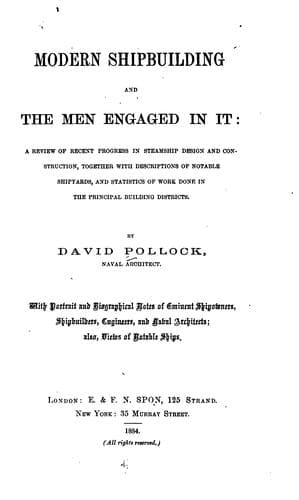
Modern shipbuilding and the men engaged in itPollock, David
History
Modern shipbuilding and the men engaged in it
Pollock, David
Shipbuilding -- Great Britain
In 1867 the firm transferred their establishment to the present
site on the east bank of the river Leven near its confluence
with the Clyde, and under the shadow of the Castle-rock, which
figures largely, alike in the scenic renown and the historic annals
of Scotland. Through a most elaborate series of extensions and
improvements carried out within the past two-and-a-half years,
the works have been enlarged to more than double their previous
dimensions, and correspondingly increased in working capability.
They occupy a total area of forty-three acres, over five acres of
which are taken up with wet dock accommodation, and as much as
seven-and-a-half acres with workshops, sheds, and roofed spaces
of various kinds. The yard has a most advantageous and extensive
frontage to the Leven, which, under the provisions of a recently
obtained Harbour Act, is being greatly improved as regards width
and deepening. The principal launching berths, eight in number,
are ranged about the centre portion of the yard’s length, and
their projections into the river Leven, favoured by a bend at this
part, are almost in the direct line of its course. Through the
recent improvements, these berths are capable of receiving vessels
of dimensions and tonnage such as the present race for big ships
has not even approached. The arrangement permits of eight vessels
being built of lengths ranging gradually from a maximum of 750 feet
downwards. Besides these principal berths, there are spaces near
the south end of the yard, where light-draught paddle-steamers and
the smaller class of screw vessels are constructed and launched, or
taken to pieces and shipped abroad. All the work of construction,
fitting out, and putting machinery on board ship, is accomplished
within the yard gates. Contributing to this result are two tidal
docks, one newly formed, of over four acres in extent, and another
of over an acre. The bottom of the new dock is 26 feet below the
level of the yard and wharfage, affording at high tide 20 feet of
water. In connection with the dock, powerful sheer-legs are being
erected by Messrs Day & Summers, of Southampton, capable of lifting
the enormous weight of one hundred tons. Alongside of the smaller
dock are a pair of sheer-legs, capable of lifting 50 tons, with
two subsidiary cranes of 10 tons each. For all purposes, either
of construction or outfit of the largest vessel, these and the
other enlarged resources place the firm in a position of entire
independence with regard to extraneous accommodation or appliances.
The engines and boilers for Messrs Denny Brothers’ vessels are
invariably supplied by Messrs Denny & Company, whose large works,
greatly extended within recent years, are situated further up the
Leven. Along the eastern boundary of the Leven Shipyard, for over
1000 feet of its length, the joiners’ shops, blacksmiths’ shops,
Public-domain text, read in full here on John Shaqi.
Reviews
Reviews
No reviews yet
Be the first to share your thoughts on this work.
Elsewhere in the archive
Join the Discussion
Join the discussion
Sign in to leave a comment or review.
Sign InorCreate an account