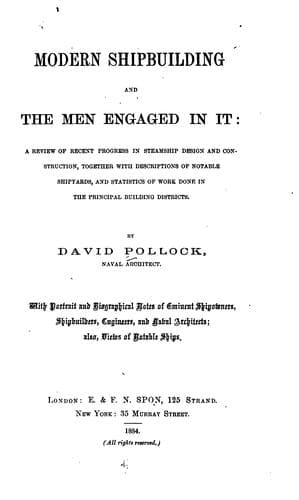
Modern shipbuilding and the men engaged in itPollock, David
History
Modern shipbuilding and the men engaged in it
Pollock, David
Shipbuilding -- Great Britain
machine sheds, outfit stores, &c., are ranged. The joiners’ shops
are most admirable for the completeness of their appointment. They
occupy the ground floor and first flat of a three-storey building,
250 feet by 65 feet, forming part of the range spoken of. The
machines contained in these apartments are of the newest and most
approved description of both British and American make, and embrace
moulding, planing, mortising, tenoning, dove-tailing, nibbling,
scraping, and sand-papering machines; circular, band, and cross-cut
saws; also machines for decorative carving and incising, &c., the
whole being driven by a special engine of considerable power,
located near the building. A large sawmill and shed, containing
various wood-working machines, are situate close to the Leven, near
the south end of the yard, and all the wood employed in the yard
is here cut from the rough. The blacksmiths’ and angle smiths’
shops and the machine sheds are correspondingly well furnished
with the most modern appliances. The former of these contain
over fifty fires, and ten steam hammers, as well as verticals,
lathes, &c., conveniently situated. The latter are splendidly
equipped, containing several large plate rolls, planing machines,
beam-bending machines, and an assortment of multiple drills and
counter-sinking machines of the most modern type; also a large
number of punching and shearing machines, including two man-hole
punches capable of piercing 30 by 20-in. holes in plates ¾-inch
thick. The plate and frame furnace, bending block, and scrive board
accommodation throughout the yard, is of extent commensurate with
the other features above described, all of which being of recent
formation, are of the most approved and modern description.
The system of railways throughout the shipyard is of an unusually
complete description. Connection is made with the main line of the
North British Railway, and enters the yard on its north side, where
a store-yard of about two acres affords ample storage accommodation
for material in steel and iron. Leaving this and traversing the
building yard throughout, the lines of railway are designed to
permit of material being conveyed without retrocession to the
vessel of which they are to form part, but with the stoppages
necessary for their being put through the various courses of
manipulation. In addition, the yard is traversed in directions
and to situations inaccessible to the main lines of rails, by the
narrow gauge portable system, patented by M. Decauville, which is
of great service.
Public-domain text, read in full here on John Shaqi.
Reviews
Reviews
No reviews yet
Be the first to share your thoughts on this work.
Elsewhere in the archive
Join the Discussion
Join the discussion
Sign in to leave a comment or review.
Sign InorCreate an account