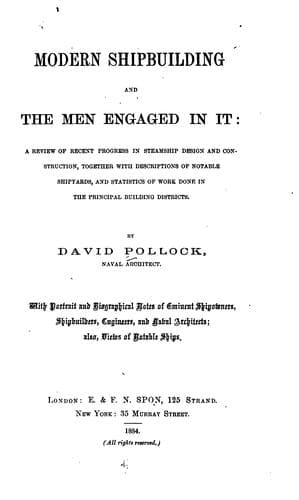
Modern shipbuilding and the men engaged in itPollock, David
History
Modern shipbuilding and the men engaged in it
Pollock, David
Shipbuilding -- Great Britain
A special department in the establishment of Messrs Denny, and an
entirely novel feature in a private shipyard, is the experimental
tank, already referred to in the Chapter on scientific progress.
This notable section of Messrs Denny’s works may be described as
consisting of a basin 300 feet long, 22 feet wide, and containing
9 feet of water over the principal portion of its length. Around
this basin are the shops and appliances for the work which has
to be done—constructive, experimental, and analytical. This work
on the constructive side consists of making paraffine models,
which represent on an appropriate scale the ships to which the
experiments have reference; the paraffine is melted, cast in a
rough mould to the approximate shape, and afterwards faired off
by a specially-constructed and very ingenious cutting machine.
When finished the model is passed on to the second stage—the
experimental. A stationary engine draws a carriage along a railway
suspended above the water space, the carriage is accompanied by
the model, with an attachment which allows the model to move
freely, and at the same time to depend entirely for its propelling
force upon a spring carried by the carriage. The extensions of
this spring are measured and recorded automatically, so too are
the speeds, the record being made by electric pens in the form of
diagrams, on a revolving cylinder which is part of the apparatus
of the carriage. The analytical work consists of obtaining from
the diagrams the items of speed and propelling force, the relation
between which, at all speeds for which the experiments have been
made, is thus obtained. The facilities which are offered by the
tank for investigating to the utmost the laws of hydrodynamics
in so far as they affect, practically, the resistance of ships,
is thus obvious. On the facade of the tank, fronting the public
street, Messrs Denny have placed an admirably-sculptured medallion
portrait of the late Mr William Froude, of Torquay, the noted
experimentalist. Underneath is the following inscription:—“This
facade of the Leven Shipyard Experimental Tank is erected in
memory of the late William Froude, F.R.S., L.L.D., the greatest
of experimenters and investigators of hydrodynamics. Born 29th
November, 1811. Died 14th May, 1879.”
Public-domain text, read in full here on John Shaqi.
Reviews
Reviews
No reviews yet
Be the first to share your thoughts on this work.
Elsewhere in the archive
Join the Discussion
Join the discussion
Sign in to leave a comment or review.
Sign InorCreate an account