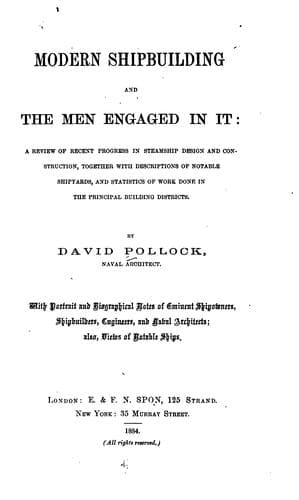
Modern shipbuilding and the men engaged in itPollock, David
History
Modern shipbuilding and the men engaged in it
Pollock, David
Shipbuilding -- Great Britain
After the abolition of the School of Naval Architecture, under Dr
Inman, in 1832, no agency for higher education existed until 1848,
when the urgent necessity for a steam re-construction of the Navy
forced attention to the want of trained men, and resulted in the
establishment of a second school at Portsmouth. The principal of
this school was Dr Woolley, an eminent graduate of the University
of Cambridge. From 1848 on to the present time, Dr Woolley has
held a prominent place amongst the promoters of naval science, and
the pupils produced by the institution under his directorship have
given in various ways good practical evidence of his capability as a
teacher. After five or six years of useful work, this second school
was done away with, and a third was established in London in 1864,
after pressure had been brought to bear upon the Government of the
day by the Institution of Naval Architects—an association which was
founded in 1860, and which has since had so flourishing an existence.
The new school was placed for a time under the control of the
Science and Art Department at South Kensington, Dr Woolley being
Inspector-General, and the late Mr C. W. Merrifield, F.R.S.,
Principal. This school, unlike its predecessors, was not nominally a
mere Admiralty establishment, but offered admission to private naval
architects and engineers, and did not exclude foreigners. It remained
in operation at South Kensington until 1873, when the Admiralty
decided to establish the Royal Naval College at Greenwich, and to
train their students of naval architecture and marine engineering
there. Since 1873, therefore, what may be regarded as a continuation
of the third school has been at work at Greenwich, the Admiralty
granting facilities for the entry of private and foreign students,
much as was done at South Kensington.
The small extent to which this institution has been taken advantage
of by private students, or by those whose aim is to equip themselves
for service in merchant shipbuilding, notwithstanding the inducements
existing in the shape of substantial scholarships, has often been
subject of comment. Various reasons have been adduced for this state
of matters, but the true cause would seem to be largely concerned
with the character of the entrance examinations and with the course
of study provided. The subject is well worthy of consideration, and
fuller reference will be made to it further on when some educational
agencies which have been recently established are under consideration.
Public-domain text, read in full here on John Shaqi.
Reviews
Reviews
No reviews yet
Be the first to share your thoughts on this work.
Elsewhere in the archive
Join the Discussion
Join the discussion
Sign in to leave a comment or review.
Sign InorCreate an account