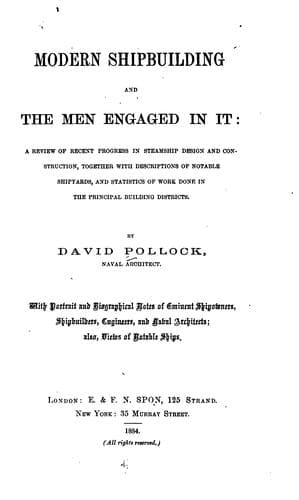
Modern shipbuilding and the men engaged in itPollock, David
History
Modern shipbuilding and the men engaged in it
Pollock, David
Shipbuilding -- Great Britain
At such important junctures in the history of shipbuilding as the
introduction of steam power for propulsion in place of sails, and
the employment of iron in place of wood for the hulls, precedent
and experience lost much of their value under the new conditions.
The association of civil and mechanical engineers with shipbuilding
at these crises was of immense advantage. Such men as Fairbairn
and Brunel, who had previously gained high reputations in other
branches, were enabled by their scientific skill in designing bridges
and other structures in wrought-iron, to achieve much, and to take
the lead in ship design and construction. “To men of this class,”
says Mr W. H. White, in the article already alluded to, “careful
preliminary investigation and calculation naturally formed part
of the work of designing ships; ‘rule of thumb’ was not likely to
find favour, even if it had been applicable, which it was not, under
the circumstances. At first, much was done on imperfect methods,
comparatively in the dark; failures were not rare; yet progress was
made, and gradually greater precision was attained, in the attempt
to design steamers capable of proceeding at certain assigned speeds
when laden to a given draught. In fact, the construction of steamers
rendered imperative a careful study of the laws of fluid resistance,
and of the cognate investigation of the mechanical theory of
propulsion—both of which subjects lay practically outside the field
of the designers of sailing ships. The speed of a sailing ship is
obviously dependent upon the force and direction of the wind; her
designer, therefore, chooses forms and proportions which will enable
a good spread of canvas to be carried, on a handy stable vessel.
Questions of resistance to the progress of the ship were therefore
subordinated to sail-carrying power and handiness in sailing ships;
whereas in steamers designed for a certain speed the question of
resistance occupies a primary place, seeing that the engine power
must be proportioned to the resistance. Consequently, while keeping
in view stability, handiness, and structural strength, the designer
of a steamer has a more difficult task than the designer of a sailing
ship, and the difficulty can only be met if faced intelligently by
scientific analysis. Hence it happened, as was previously remarked,
that a more general appreciation of the value of scientific methods
accompanied the development of steam navigation and iron shipbuilding
in the British mercantile marine.”
Public-domain text, read in full here on John Shaqi.
Reviews
Reviews
No reviews yet
Be the first to share your thoughts on this work.
Elsewhere in the archive
Join the Discussion
Join the discussion
Sign in to leave a comment or review.
Sign InorCreate an account