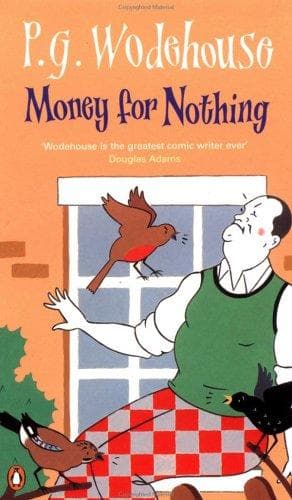
Money for nothingWodehouse, P. G. (Pelham Grenville)
General
Money for nothing
Wodehouse, P. G. (Pelham Grenville)
Greed -- Fiction; Humorous stories; Swindlers and swindling -- Fiction
"I think we ought to have some new Alpha Separators."
"What?"
"Alpha Separators."
"Why?"
"We need them."
"Why?"
"The old ones are past their work."
"What," inquired Mr. Carmody, "is an Alpha Separator?"
John said it was an Alpha Separator.
There was a pause. John, who appeared to have something on his mind
these days, stared gloomily at the carpet. Mr. Carmody shifted in his
chair.
"Very well," he said.
"And new tractors," said John. "And we could do with a few harrows."
"Why do you want harrows?"
"For harrowing."
Even Mr. Carmody, anxious though he was to find flaws in the other's
reasoning, could see that this might well be so. Try harrowing without
harrows, and you are handicapped from the start. But why harrow at
all? That was what seemed to him superfluous and wasteful. Still, he
supposed it was unavoidable. After all, John had been carefully trained
at an agricultural college after leaving Oxford and presumably knew.
"Very well," he said.
"All right," said John.
He went out, and Mr. Carmody experienced a little relief at the thought
that he had now heard all this morning's bad news.
But dairy farmers have second thoughts. The door opened again.
"I was forgetting," said John, poking his head in.
Mr. Carmody uttered a low moan.
"We want some Thomas tap-cinders."
"Thomas what?"
"Tap-cinders."
"Thomas tap-cinders?"
"Thomas tap-cinders."
Mr. Carmody swallowed unhappily. He knew it was no use asking what
these mysterious implements were, for his nephew would simply reply
that they were Thomas tap-cinders or that they were something invented
by a Mr. Thomas for the purpose of cinder-tapping, leaving his brain in
the same addled condition in which it was at present. If John wished to
tap cinders, he supposed he must humour him.
"Very well," he said dully.
He held his breath for a few moments after the door had closed once
more, then, gathering at length that the assault on his purse was over,
expelled it in a long sigh and gave himself up to bleak meditation.
The lot of the English landed proprietor, felt Mr. Carmody, is not what
it used to be in the good old times. When the first Carmody settled in
Rudge he had found little to view with alarm. He was sitting pretty,
and he admitted it. Those were the days when churls were churls, and a
scurvy knave was quite content to work twelve hours a day, Saturdays
included, in return for a little black bread and an occasional nod of
approval from his overlord. But in this Twentieth-Century England's
peasantry has degenerated. They expect coddling. Their roofs leak, and
you have to mend them; their walls fall down and you have to build them
up; their lanes develop holes and you have to restore the surface,
and all this runs into money. The way things were shaping, felt Mr.
Carmody, in a few years a landlord would be expected to pay for the
repairs of his tenants' wireless sets.
Public-domain text, read in full here on John Shaqi.
Reviews
Reviews
No reviews yet
Be the first to share your thoughts on this work.
Join the Discussion
Join the discussion
Sign in to leave a comment or review.
Sign InorCreate an account