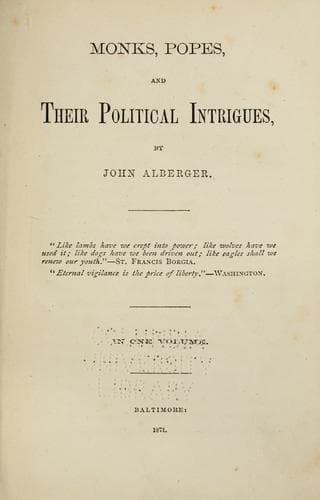
Monks, Popes, and their Political IntriguesAlberger, John
History
Monks, Popes, and their Political Intrigues
Alberger, John
Catholic Church; Catholic Church -- United States; Church and state
The right of the monarch of the world to temporal power, which was first
founded upon the usurpation of Constantine, and next upon the conquests
of Pepin, was annihilated by the conquests of the Lombards. Desiderious,
their king, wrested the Exercate from Rome; and wishing to subjugate
Charlemagne under his authority, proposed to Pope Adrian I. that he
should excite the subjects of that prince to rebellion, declare him a
usurper, and crown his nephews in his place. Adrian listened to these
overtures with seeming friendship, but with malignant delight, and
secretly communicating their substance to Charlemagne, the sword of the
latter was immediately drawn in behalf of the church; the pope revenged;
Desiderius imprisoned for life in a monastery; and all Italy, except the
Duchy of Benevento and the lower Italian republics, were reconquered.
Upon this signal success of his arms, it is alleged by the popes that
the blood-stained warrior, to purchase masses for the benefit of his
soul, confirmed the Holy See in the absolute possession of the former
grants of Pepin. The only copy ever known of these pretended donations
is one received by Cancio, the pope's chamberlain, in the twelfth
century. The undeniable historical fact that Charlemagne asserted, and
maintained during his whole life, a jealous and inalienable right to
Rome, and to every other portion of his dominions, casts a dark shade
of suspicion upon the genuineness of these documents. Even were they,
authenticated, yet as the right of a monarch to annul is equal to
his right to grant, and as his practice is the evidence of what he
surrenders or annuls, the exclusive sovereignty which Charlemagne
maintained over his Italian conquests, until the day of his death, is
a complete nullification of any grant that he had made to the pope, and
positive proof that any right or title to Rome, or to temporal power,
constructed upon them by the holy fathers, is as invalid, futile and
ludicrous, as if they were based on a grant from the man in the moon; in
whose place of abode a traveller, according to Ariosto, once found some
of the lost documents upon which the popes base their claim to temporal
dominion. Besides these laborious but ineffectual efforts to fabricate
historical data in support of the papal pretension to temporal
sovereignty, Gregory VII., in 1075 asserted that Matilda, Duchess of
Tuscany, had bequeathed to the church her domains. These possessions
consisted of Tuscany, a part of Umbria, a part of Mark Ancona, and
the Duchies of Spoleto and Verona. The validity of these bequests was
disputed by the natural heirs; the contest lasted three hundred years,
during which Italy was distracted, and Germany depopulated. Frederic
I., in vindication of his claims against the pretensions of the pope,
invaded Italy on three different occasions. Henry IV. emperor of
Germany, thrice crossed the Alps to chastise the popes for aggressions
on the Germanic possessions in Italy. During the first campaign pope
Public-domain text, read in full here on John Shaqi.
Reviews
Reviews
No reviews yet
Be the first to share your thoughts on this work.
Elsewhere in the archive
Join the Discussion
Join the discussion
Sign in to leave a comment or review.
Sign InorCreate an account