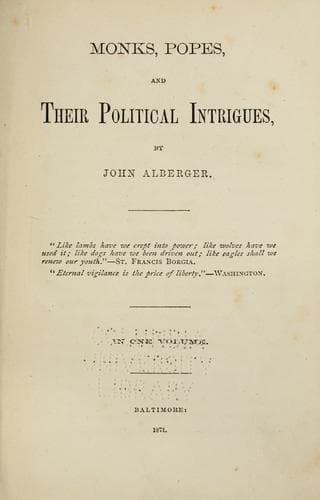
Monks, Popes, and their Political IntriguesAlberger, John
History
Monks, Popes, and their Political Intrigues
Alberger, John
Catholic Church; Catholic Church -- United States; Church and state
Paschal was made a prisoner; but on the approach of the imperial army
a second time he fled from Rome. Yet amid the disputes of the Germanic
succession, and during the minority of Frederic II., the arms and
intrigues of the pope won the concession of Europe to his claim of
Matilda's estates.
The spurious character of the pope's title to temporal power has been
exposed by the ablest Catholic authors, and rejected with impatient
contempt by history. But the arguments which have converted a world,
have never been able to convert the popes. They still maintain that
the reputed donations of Constantine, of Pepin, of Charlemagne and of
Matilda, are real and valid. This assertion may appear incredible, but
in 1822 Marino Malini, the pope's chamberlain, endeavored to establish
the genuineness of the fictitious charters of Louis-de-Debonnaire, of
Otho I., and of Henry II., in vindication of the pope's titles of the
alleged grants to the See of Rome.
If the apostolic chair of St. Peter is endowed with a divine title
to universal temporal sovereignty, a human title is superfluous. The
indefatigable exertions of the popes to establish a human title to their
temporal possessions, is a concession that they have no divine title
to them, and that a human title is necessary to the validity of their
claim. But as they have based their title on the authority of forged
documents, and endeavored to fortify and maintain it by successive
fabrications of the same nature, it is evident that they are fully and
alarmingly conscious that they have no title, either by virtue of their
office, or by that of any donation whatever, to temporal possession or
Authority.
Not only is the holy fathers temporal power a usurpation, but so is also
his exclusive claim to the use of the title of pope. Every bishop, and
even some laymen, in the first centuries of Christianity, bore this
title. In the ancient Greek church it was bestowed upon every clergyman.
At the General Council of Constantinople, in 869, its adoption was first
limited to the four patriarchs. And in the course of the usurpations of
the holy fathers, pope Gregory VII., by authority of an Italian Council,
finally assumed it as the exclusive title of the bishops of Rome.
The popes, the monarchs of the world, in vindicating their title to
the States of the Church, had to maintain a long, bloody and desperate
struggle, during which their domains were abridged or enlarged, lost or
wont according to the varying fortunes of their arms and intrigues.
But as these warlike enterprises of the holy fathers were intimately
connected with the convulsions and revolutions of Europe, it will
prevent repetition by deferring further allusion to them until we
arrive at the subsequent chapters, in which we shall consider the papal
political intrigues in general.
Public-domain text, read in full here on John Shaqi.
Reviews
Reviews
No reviews yet
Be the first to share your thoughts on this work.
Elsewhere in the archive
Join the Discussion
Join the discussion
Sign in to leave a comment or review.
Sign InorCreate an account