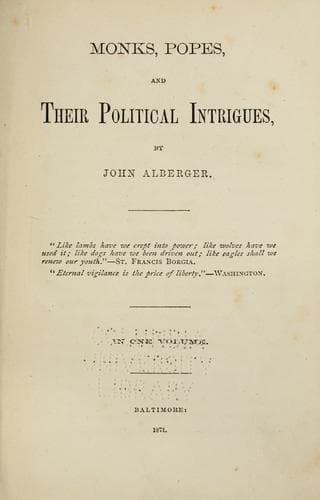
Monks, Popes, and their Political IntriguesAlberger, John
History
Monks, Popes, and their Political Intrigues
Alberger, John
Catholic Church; Catholic Church -- United States; Church and state
The political security and religious liberty which Henry IV. had secured
to the subjects were annulled by the repeal of the Edict of Nantes, and
Catholic intolerance again domineered over the lives and fortunes of
Protestants. Kings had been taught by their teachers and spiritual
guides that "to dissemble was to reign," and that "to become a great
man it was necessary to become a great villain." The consequence was
national weakness and demoralization. Mock treaties were made to conceal
real ones, and kings, to disguise their intentions, acted differently
from what they thought. A succession of weak, bigoted, tyrannical, and
criminal rulers had oppressed the industry of the country, and drove
thousands of subjects to seek a livelihood under less oppressive
government. Despotic ministers, rapacious favorites, intriguing
prostitutes, foolish enterprises absurd laws, professed rakes in the
garb of priests and cardinals, prodigality, corruption and tyranny
withering the vitality of the nation, and accumulating on the heads
of the people an insupportable load of taxation and misery, were the
deplorable results of the operation of the pope and his political
engine. But while such were the calamities which Catholicism was
maturing, the eloquent writings of Voltaire, of Rousseau, and other
liberal authors were awakening a spirit of inquiry in the public mind,
and preparing the way for political regeneration. The smouldering
fires of freedom which burned in the breast of the nation, rendered the
conflict between monarchy and republicanism inevitable. It finally
took place; the majesty of the people was vindicated; and, a national
assembly convened consisting of three hundred and seventeen clergy
men, three hundred and seventeen nobles, and six hundred and seventeen
deputies of the people; all of whom took an oath never to separate
until they had given France a free constitution, From the ruins of the
monarchy a republic arose in majesty and power. The feudal estates were
abolished without indemnification. The invidious game laws, the
feudal tribunals, the church tithes, the ecclesiastical revenues, the
hereditary descent of officers, the exemption of church dignities from
military taxation, the laws excluding Protestants from offices of
trust or profit, and denying them the right of inheriting, acquiring or
bequeathing property, and all that the toil of the papal machinery had
accumulated on the heads of the people, were swept away by the spirit of
liberal government. To obtain this freedom the nation had poured out
its blood. But the nation had been educated in Catholic bigotry and
intolerance; and now it visited on the heads of its tutors the lessons
which they had taught. The people swept away the despotism of the
throne, but left it remaining in the national councils; and, while
they made a wreck of oppression, they preserved its elements to be
reconstructed in another form. It is not, then, surprising, that hard
Public-domain text, read in full here on John Shaqi.
Reviews
Reviews
No reviews yet
Be the first to share your thoughts on this work.
Elsewhere in the archive
Join the Discussion
Join the discussion
Sign in to leave a comment or review.
Sign InorCreate an account