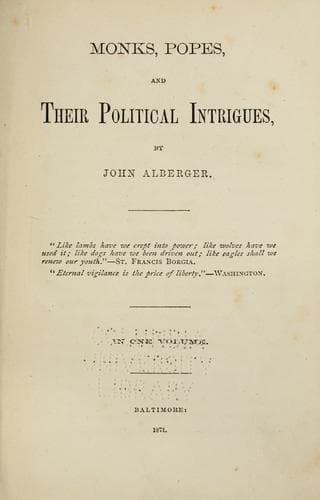
Monks, Popes, and their Political IntriguesAlberger, John
History
Monks, Popes, and their Political Intrigues
Alberger, John
Catholic Church; Catholic Church -- United States; Church and state
as their freedom was won, it was so easily betrayed by the genius of
Napoleon Bonaparte, once its advocate, but always its foe; who hated
republicanism as much as he hated papacy, for they both were in
conflict with his designs; and who loved nothing but himself and supreme
dominion. But the boon he sought his ambition defeated. While he stood
at the height of his fortune, with the conquest of Europe in his grasp,
the mask fell from his brow. The confidence of freemen forsook him;
and his glory, which else might have outrivalled the splendor of the
greatest, flickered, grew dim, and soon vanished away; leaving the
world as much astonished at the obscurity it left as it had been at the
effulgence it had emitted.
CHAPTER XIV. PAPAL POLITICAL INTRIGUES IN GERMANY.
Papal Intrigues in Germany under the reigns of Otho I--of
Henry IV.--of Henry V--of Frederic I--of Frederic II--of
Conrad IV.--of ALbert I--of Henry VII--of Louis of Bavaria--
of Charles IV.--of Sigis-mund--of Charles V.--of Ferdinand
II,--Papal Intrigues in Austria--in Prussia--and in the
Netherlands.
Wittikind the Great, King of Saxony, after a vigorous resistance for
thirty-three years against the arms of Charlemagne, the confederate of
the pope, submitted to be baptized to spare the further effusion of
the blood of his subjects. But in the events of one hundred years, the
conquered became the emperors, and the Franks were supplanted on the
throne by the Saxons. From the time that the Carlovingian dynasty was
established until the dissolution of the empire in 1806, the secular
power had to continually struggle against the intrigues and usurpations
of the Papal See.
The pope's claim of being the disposer of crowns, and the source of
secular power, achieved something of a triumph in 962, when through a
crafty policy the pontiff bestowed the diadem on Otho. From motives
of policy the emperor conceded the spiritual claims of the pope, but
prudently nullified them by placing him under his authority. While Otho
acknowledged that he was emperor by the grace of God and the pope, he
required the latter, who was John XII., to swear allegiance to him, and
the Roman See to enter into a solemn agreement with him that henceforth
no pope should be chosen except in the presence of a Germanic imperial
commission. This judicious check on the intriguing policy of the Papal
See, was too unpleasant to be tolerated longer than weakness made it
unavoidable. Presumptuous as false, Pope John XII. was led to violate
his oath of allegiance, and to take up arms to acquire independence of
secular authority. For this act of perjury, treason, and violation of a
solemn treaty--which in a layman would have been a capital offence, but
in a priest was aggravated by the additional crime of hypocrisy--the
emperor could not do less than depose him.
Public-domain text, read in full here on John Shaqi.
Reviews
Reviews
No reviews yet
Be the first to share your thoughts on this work.
Elsewhere in the archive
Join the Discussion
Join the discussion
Sign in to leave a comment or review.
Sign InorCreate an account