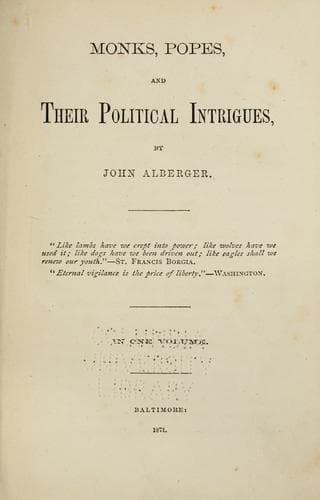
Monks, Popes, and their Political IntriguesAlberger, John
History
Monks, Popes, and their Political Intrigues
Alberger, John
Catholic Church; Catholic Church -- United States; Church and state
mockery he dressed himself in mourning for the pope, ordered masses
to be said in all the churches for his deliverance from prison, and in
alleviation of his misfortune reduced the ransom to 100,000 crowns, The
power of Charles overawing the papal throne, it prudently refrained
from venting in insulting anathemas the ebullitions of its wrath. Pope
Clement VII., after the peace of Cambray in 1592, crowned Charles as
King of Lombardy and Rome.
On this occasion the emperor dutifully kissed the feet of the papal
monarch. The cause of this affection and harmony was shortly afterwards
manifested in an intolerant edict against the Protestants. This
significant menace led the Protestant princes to form the Smalkalden
League for the protection of Protestantism. Two years afterwards a
holy league was formed by the Catholic princes for the protection of
Catholicism. After some abortive attempts at negotiation, the Protestant
league raised the standard of war. The emperor by strategetic
movements, and by creating jealousy and divisions among the Protestant
confederates, obtained important advantages over their arms, and finally
succeeded in dissolving the league. But Maurice of Saxony had secretly
formed another league, which was joined by Henry II., King of France.
While Charles was at Innspruck, attending the Council of Trent, Maurice
suddenly appeared at the head of an army, and the emperor barely escaped
amid the darkness of a stormy night from being captured. The council was
consequently dissolved, and the Protestants dictated the terms of peace
at Passau; which the emperor ratified at Augsburg. By the terms of this
treaty it was agreed that no one should be attacked on account of his
religious belief; that no one should be molested in the enjoyment of his
property or mode of worship; that religious disputes should be adjusted
by pacific means; that persons for religious reasons should be allowed
to change their residences; that bishops on becoming Protestants should
forfeit their office and salary; and that every Protestant should enjoy
his faith until a religious compromise should be established!
Charles, broken down in health and constitution, enfeebled in mind, and
conceiving that he was haunted by some invisible power which blasted all
his prospects, abdicated the throne and retired to a monastery, where
he passed the remainder of his life in making wooden clocks, and in
performing his funeral ceremonies.
Public-domain text, read in full here on John Shaqi.
Reviews
Reviews
No reviews yet
Be the first to share your thoughts on this work.
Elsewhere in the archive
Join the Discussion
Join the discussion
Sign in to leave a comment or review.
Sign InorCreate an account