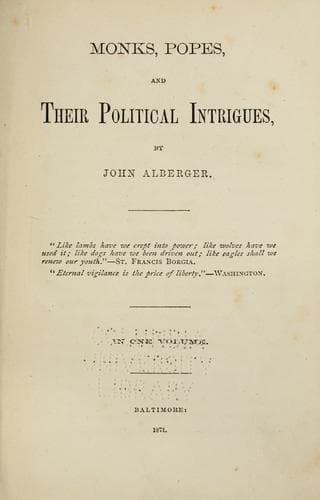
Monks, Popes, and their Political IntriguesAlberger, John
History
Monks, Popes, and their Political Intrigues
Alberger, John
Catholic Church; Catholic Church -- United States; Church and state
Ferdinand II., King of Spain, succeeded to the crown of Germany in 1619.
He was by nature of a morose and revengeful disposition, and the
bigotry and prejudice which had been instilled into his mind by Catholic
preceptors made him an accomplished instrument in the hands of the
church, in executing its exterminating vengeance on the heretics. During
the course of his tutelage he made a pilgrimage to Rome, where an oath
was administered to him by the pope, that if he should ever become
emperor he would exterminate heresy in his dominions. When he ascended
the throne Germany was divided into two factions. The one was known as
the "Catholic League," and the other as the "Evangelical Union." The
Catholic League was headed by Maximilian, elector of Bavaria, and
comprised the bishops and princes attached to the house of Austria.
The Evangelical Union was headed by the Duke of Wittenberg, the elector
of Saxony and Brandenburg, and composed of Lutheran and Calvinistic
princes and knights. A number of the princes of Bavaria assembled at
Prague, and declaring that they would not submit to Maximilian, chose
for their king Frederic, elector of the Palatina, a member of the
Evangelical Union. This revolt benefited the Evangelical Union by a
powerful accession. A desperate and bloody struggle was imminent between
these two parties. Notwithstanding the Protestant influence in Bavaria,
Ferdinand succeeded in having himself elected king. After this event he
tore up in a violent rage the charter which Rudolph II. had granted the
Bohemians, because it allowed them to build churches and school-houses.
He then showed his remembrance of his popish oath by persecuting the
Protestants, banishing their preachers, and depopulating the kingdom
by an intolerance which caused emigrations of whole sections from his
dominions. The victory of his troops near Prague enabling him to
dictate a treaty which crushed the Protestant cause, and dissolved
the Evangelical Union, he proceeded to restore the ecclesiastical
institutions which had been abolished by the Protestants, to exclude
Calvinists from the benefits of the religious peace of Augsburg, and
to require Protestants living under Catholic princes to believe in
Catholicism. Besides these decrees, enforced by the military power, the
conquest of the Palatinate of Frederic, the bestowal of that dignity on
Maximilian, the emperor's favorite, giving the Catholics the ascendency
in the electoral college, the army of Tilly in Lower Saxony, where no
existing enemy made it excusable, depriving the Protestants of their
churches, committing wanton violence on the Lutherans, and compelling
thousands to abandon their homes, property and country, were such gross
violations of treaties, and such strong incentives to resistance, that
the Protestant princes were impelled to unite in a league with the
King of Denmark and the Duke of Holstein, determining to exhaust every
resource in the defence of religious liberty. After some successes the
Public-domain text, read in full here on John Shaqi.
Reviews
Reviews
No reviews yet
Be the first to share your thoughts on this work.
Elsewhere in the archive
Join the Discussion
Join the discussion
Sign in to leave a comment or review.
Sign InorCreate an account