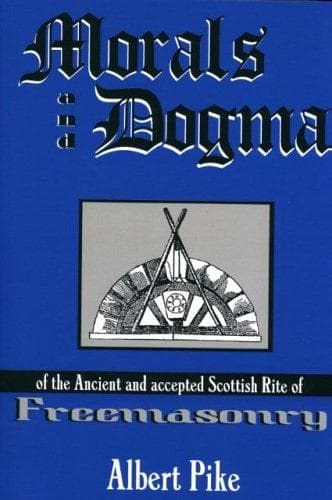
Morals and Dogma of the Ancient and Accepted Scottish Rite of FreemasonryPike, Albert
Religion
Morals and Dogma of the Ancient and Accepted Scottish Rite of Freemasonry
Pike, Albert
Freemasons
Idleness is the burial of a living man. For an idle person is so useless
to any purposes of God and man, that he is like one who is dead,
unconcerned in the changes and necessities of the world; and he only
lives to spend his time, and eat the fruits of the earth. Like a vermin
or a wolf, when his time comes, he dies and perishes, and in the
meantime is nought. He neither ploughs nor carries burdens: all that he
does is either unprofitable or mischievous.
It is a vast work that any man may do, if he never be idle: and it is a
huge way that a man may go in virtue, if he never go out of his way by a
vicious habit or a great crime: and he who perpetually reads good
books, if his parts be answerable, will have a huge stock of knowledge.
St. Ambrose, and from his example, St. Augustine, divided every day into
these _tertias_ of employment: eight hours they spent in the necessities
of nature and recreation: eight hours in charity, in doing assistance to
others, dispatching their business, reconciling their enmities,
reproving their vices, correcting their errors, instructing their
ignorance, and in transacting the affairs of their dioceses; and the
other eight hours they spent in study and prayer.
We think, at the age of twenty, that life is much too long for that
which we have to learn and do; and that there is an almost fabulous
distance between our age and that of our grandfather. But when, at the
age of sixty, if we are fortunate enough to reach it, or unfortunate
enough, as the case may be, and according as we have profitably invested
or wasted our time, we halt, and look back along the way we have come,
and cast up and endeavor to balance our accounts with time and
opportunity, we find that we have made life much too short, and thrown
away a huge portion of our time. Then we, in our mind, deduct from the
sum total of our years the hours that we have needlessly passed in
sleep; the working-hours each day, during which the surface of the
mind's sluggish pool has not been stirred or ruffled by a single
thought; the days that we have gladly got rid of, to attain some real or
fancied object that lay beyond, in the way between us and which stood
irksomely the intervening days; the hours worse than wasted in follies
and dissipation, or misspent in useless and unprofitable studies; and we
acknowledge, with a sigh, that we could have learned and done, in half a
score of years well spent, more than we _have_ done in all our forty
years of manhood.
Public-domain text, read in full here on John Shaqi.
Reviews
Reviews
No reviews yet
Be the first to share your thoughts on this work.
Elsewhere in the archive
Join the Discussion
Join the discussion
Sign in to leave a comment or review.
Sign InorCreate an account