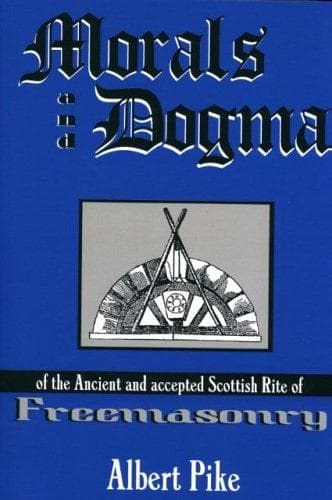
Morals and Dogma of the Ancient and Accepted Scottish Rite of FreemasonryPike, Albert
Religion
Morals and Dogma of the Ancient and Accepted Scottish Rite of Freemasonry
Pike, Albert
Freemasons
And yet the mind is in reality little known or considered. It is _all_
which man permanently _is_, his inward being, his divine energy, his
immortal thought, his boundless capacity, his infinite aspiration; and
nevertheless, few value it for what it is worth. Few see a brother-mind
in others, through the rags with which poverty has clothed it, beneath
the crushing burdens of life, amidst the close pressure of worldly
troubles, wants and sorrows. Few acknowledge and cheer it in that humble
blot, and feel that the nobility of earth, and the commencing glory of
Heaven are there.
Men do not feel the worth of their own souls. They are proud of their
mental powers; but the intrinsic, inner, infinite _worth_ of their own
minds they do not perceive. The poor man, admitted to a palace, feels,
lofty and immortal being as he is, like a mere ordinary thing amid the
splendors that surround him. He sees the carriage of wealth roll by him,
and forgets the intrinsic and eternal dignity of his own mind in a poor
and degrading envy, and feels as an humbler creature, because others are
above him, not in mind, but in mensuration. Men respect themselves,
according as they are more wealthy, higher in rank or office, loftier in
the world's opinion, able to command more votes, more the favorites of
the people or of Power.
The difference among men is not so much in their nature and intrinsic
power, as in the faculty of communication. Some have the capacity of
uttering and embodying in words their thoughts. All men, more or less,
_feel_ those thoughts. The glory of genius and the rapture of virtue,
when rightly revealed, are diffused and shared among unnumbered minds.
When eloquence and poetry speak; when those glorious arts, statuary,
painting, and music, take audible or visible shape; when patriotism,
charity, and virtue speak with a thrilling potency, the hearts of
thousands glow with kindred joy and ecstasy. If it were not so, there
would be no eloquence; for eloquence is that to which other hearts
respond; it is the faculty and power of _making_ other hearts respond.
No one is so low or degraded, as not sometimes to be touched with the
beauty of goodness. No heart is made of materials so common, or even
base, as not sometimes to respond, through every chord of it, to the
call of honor, patriotism, generosity, and virtue. The poor African
Slave will die for the master or mistress, or in defence of the
children, whom he loves. The poor, lost, scorned, abandoned, outcast
woman will, without expectation of reward, nurse those who are dying on
every hand, utter strangers to her, with a contagious and horrid
pestilence. The pickpocket will scale burning walls to rescue child or
woman, unknown to him, from the ravenous flames.
Public-domain text, read in full here on John Shaqi.
Reviews
Reviews
No reviews yet
Be the first to share your thoughts on this work.
Elsewhere in the archive
Join the Discussion
Join the discussion
Sign in to leave a comment or review.
Sign InorCreate an account