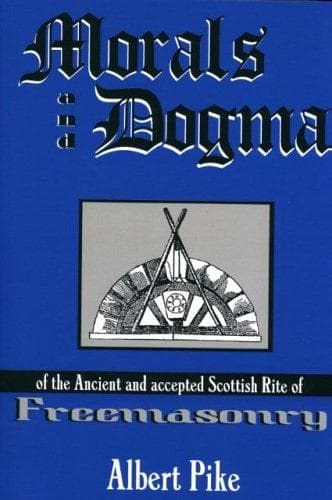
Morals and Dogma of the Ancient and Accepted Scottish Rite of FreemasonryPike, Albert
Religion
Morals and Dogma of the Ancient and Accepted Scottish Rite of Freemasonry
Pike, Albert
Freemasons
The three great lights of the Lodge are symbols to us of the Power,
Wisdom, and Beneficence of the Deity. They are also symbols of the first
three _Sephiroth_, or Emanations of the Deity, according to the Kabalah,
_Kether_, the omnipotent divine _will_; _Chochmah_, the divine
intellectual _power_ to _generate_ thought, and _Binah_, the divine
intellectual _capacity_ to _produce_ it--the two latter, usually
translated _Wisdom_ and _Understanding_, being the _active_ and the
_passive_, the _positive_ and the _negative_, which we do not yet
endeavor to explain to you. They are the columns Jachin and Boaz, that
stand at the entrance to the Masonic Temple.
In another aspect of this Degree, the Chief of the Architects [[Hebrew:
רב בנים], Rab Banaim,] symbolizes the constitutional executive head and
chief of a free government; and the Degree teaches us that no free
government can long endure, when the people cease to select for their
magistrates the best and the wisest of their statesmen; when, passing
these by, they permit factions or sordid interests to select for them
the small, the low, the ignoble, and the obscure, and into such hands
commit the country's destinies. There is, after all, a "divine right" to
govern; and it is vested in the ablest, wisest, best, of every nation.
"Counsel is mine, and sound wisdom: I am understanding: I am power: by
me kings do reign, and princes decree justice; by me princes rule, and
nobles, even all the magistrates of the earth."
For the present, my Brother, let this suffice. We welcome you among us,
to this peaceful retreat of virtue, to a participation in our
privileges, to a share in our joys and our sorrows.
[Illustration]
[Illustration]
XIII.
ROYAL ARCH OF SOLOMON.
Whether the legend and history of this Degree are historically true, or
but an allegory, containing in itself a deeper truth and a profounder
meaning, we shall not now debate. If it be but a legendary myth, you
must find out for yourself what it means. It is certain that the word
which the Hebrews are not now permitted to pronounce was in common use
by Abraham, Lot, Isaac, Jacob, Laban, Rebecca, and even among tribes
foreign to the Hebrews, before the time of Moses; and that it recurs a
hundred times in the lyrical effusions of David and other Hebrew poets.
Public-domain text, read in full here on John Shaqi.
Reviews
Reviews
No reviews yet
Be the first to share your thoughts on this work.
Elsewhere in the archive
Join the Discussion
Join the discussion
Sign in to leave a comment or review.
Sign InorCreate an account