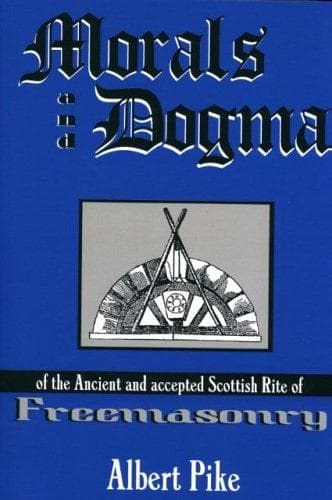
Morals and Dogma of the Ancient and Accepted Scottish Rite of FreemasonryPike, Albert
Religion
Morals and Dogma of the Ancient and Accepted Scottish Rite of Freemasonry
Pike, Albert
Freemasons
We know that for many centuries the Hebrews have been forbidden to
pronounce the Sacred Name; that wherever it occurs, they have for ages
read the word _Adonaï_ instead; and that under it, when the masoretic
points, which represent the vowels, came to be used, they placed those
which belonged to the latter word. The possession of the true
pronunciation was deemed to confer on him who had it extraordinary and
supernatural powers; and the Word itself, worn upon the person, was
regarded as an amulet, a protection against personal danger, sickness,
and evil spirits. We know that all this was a vain superstition, natural
to a rude people, necessarily disappearing as the intellect of man
became enlightened; and wholly unworthy of a Mason.
It is noticeable that this notion of the sanctity of the Divine Name or
Creative Word was common to all the ancient nations. The Sacred Word HOM
was supposed by the ancient Persians (who were among the earliest
emigrants from Northern India) to be pregnant with a mysterious power;
and they taught that by its utterance the world was created. In India it
was forbidden to pronounce the word AUM or OM, the Sacred Name of the
One Deity, manifested as Brahma, Vishna, and Seeva.
These superstitious notions in regard to the efficacy of the Word, and
the prohibition against pronouncing it, could, being errors, have formed
no part of the pure primitive religion, or of the esoteric doctrine
taught by Moses, and the full knowledge of which was confined to the
Initiates; unless the whole was but an ingenious invention for the
concealment of some other Name or truth, the interpretation and meaning
whereof was made known only to the _select few_. If so, the common
notions in regard to the Word grew up in the minds of the people, like
other errors and fables among all the ancient nations, out of original
truths and symbols and allegories misunderstood. So it has always been
that allegories, intended as vehicles of truth, to be understood by the
sages, have become or bred errors, by being literally accepted.
It is true, that before the masoretic points were invented (which was
after the beginning of the Christian era), the pronunciation of a word
in the Hebrew language could not be known from the characters in which
it was written. It was, therefore, _possible_ for that of the name of
the Deity to have been forgotten and lost. It is certain that its true
pronunciation is not that represented by the word Jehovah; and therefore
that _that_ is not the true name of Deity, nor the Ineffable Word.
Public-domain text, read in full here on John Shaqi.
Reviews
Reviews
No reviews yet
Be the first to share your thoughts on this work.
Elsewhere in the archive
Join the Discussion
Join the discussion
Sign in to leave a comment or review.
Sign InorCreate an account