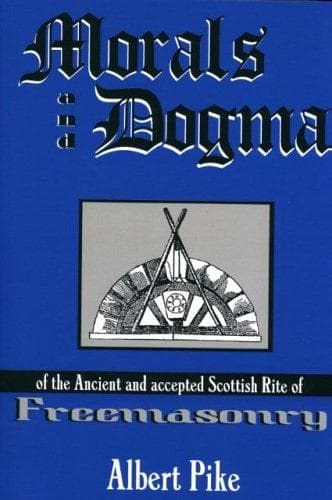
Morals and Dogma of the Ancient and Accepted Scottish Rite of FreemasonryPike, Albert
Religion
Morals and Dogma of the Ancient and Accepted Scottish Rite of Freemasonry
Pike, Albert
Freemasons
To the Mason, God is our Father in Heaven, to be Whose especial children
is the sufficient reward of the peacemakers, to see Whose face the
highest hope of the pure in heart; Who is ever at hand to strengthen His
true worshippers; to Whom our most fervent love is due, our most humble
and patient submission; Whose most acceptable worship is a pure and
pitying heart and a beneficent life; in Whose constant presence we live
and act, to Whose merciful disposal we are resigned by that death which,
we hope and believe, is but the entrance to a better life; and Whose
wise decrees forbid a man to lap his soul in an elysium of mere indolent
content.
As to our feelings toward Him and our conduct toward man, Masonry
teaches little about which men can differ, and little from which they
can dissent. He is our _Father_; and we are all _brethren_. This much
lies open to the most ignorant and busy, as fully as to those who have
most leisure and are most learned. This needs no Priest to teach it, and
no authority to indorse it; and if every man did that only which is
consistent with it, it would exile barbarity, cruelty, intolerance,
uncharitableness, perfidy, treachery, revenge, selfishness, and all
their kindred vices and bad passions beyond the confines of the world.
The true Mason, sincerely holding that a Supreme God created and governs
this world, believes also that He governs it by laws, which, though
wise, just, and beneficent, are yet steady, unwavering, inexorable. He
believes that his agonies and sorrows are ordained for _his_ chastening,
_his_ strengthening, _his_ elaboration and development; because they are
the necessary results of the operation of laws, the best that could be
devised for the happiness and purification of the species, and to give
occasion and opportunity for the practice of all the virtues, from the
homeliest and most common, to the noblest and most sublime; or perhaps
not even that, but the best adapted to work out the vast, awful,
glorious, eternal designs of the Great Spirit of the Universe. He
believes that the ordained operations of nature, which have brought
misery to him, have, from the very unswerving tranquility of their
career, showered blessings and sunshine upon many another path; that the
unrelenting chariot of Time, which has crushed or maimed him in its
allotted course, is pressing onward to the accomplishment of those
serene and mighty purposes, to have contributed to which, even as a
victim, is an honor and a recompense. He takes this view of Time and
Nature and God, and yet bears his lot without murmur or distrust;
because it is a portion of a system, the best possible, because ordained
by God. He does not believe that God loses sight of _him_, while
superintending the march of the great harmonies of the Universe; nor
that it was not foreseen, when the Universe was created, its laws
enacted, and the long succession of its operations pre-ordained, that in
Public-domain text, read in full here on John Shaqi.
Reviews
Reviews
No reviews yet
Be the first to share your thoughts on this work.
Elsewhere in the archive
Join the Discussion
Join the discussion
Sign in to leave a comment or review.
Sign InorCreate an account