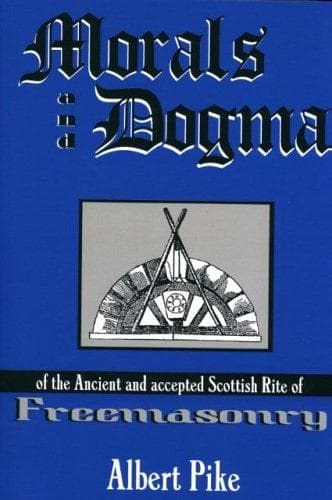
Morals and Dogma of the Ancient and Accepted Scottish Rite of FreemasonryPike, Albert
Religion
Morals and Dogma of the Ancient and Accepted Scottish Rite of Freemasonry
Pike, Albert
Freemasons
the great march of those events, he would suffer pain and undergo
calamity. He believes that his individual good entered into God's
consideration, as well as the great cardinal results to which the course
of all things is tending.
Thus believing, he has attained an eminence in virtue, the highest, amid
_passive_ excellence, which humanity can reach. He finds his reward and
his support in the reflection that he is an unreluctant and
self-sacrificing co-operator with the Creator of the Universe; and in
the noble consciousness of being worthy and capable of so sublime a
conception, yet so sad a destiny. He is then truly entitled to be
called a Grand Elect, Perfect, and Sublime Mason. He is content to fall
early in the battle, if his body may but form a stepping-stone for the
future conquests of humanity.
It cannot be that God, Who, we are certain, is perfectly good, can
choose us to suffer pain, unless either we are ourselves to receive from
it an antidote to what is evil in ourselves, or else as such pain is a
necessary part in the scheme of the Universe, which as a whole is good.
In either case, the Mason receives it with submission. He would not
suffer unless it was ordered so. Whatever his creed, if he believes that
God is, and that He cares for His creatures, he cannot doubt that; nor
that it would not have been so ordered, unless it was either better for
himself, or for some other persons, or for some things. To complain and
lament is to murmur against God's will, and worse than unbelief.
The Mason, whose mind is cast in a nobler mould than those of the
ignorant and unreflecting, and is instinct with a diviner life,--who
loves truth more than rest, and the peace of Heaven rather than the
peace of Eden,--to whom a loftier being brings severer cares,--who knows
that man does not live by pleasure or content alone, but by the presence
of the power of God,--must cast behind him the hope of any other repose
or tranquillity, than that which is the last reward of long agonies of
thought; he must relinquish all prospect of any Heaven save that of
which trouble is the avenue and portal; he must gird up his loins, and
trim his lamp, for a work that must be done, and must not be negligently
done. If he does not like to live in the furnished lodgings of
tradition, he must build his own house, his own system of faith and
thought, for himself.
The hope of success, and not the hope of reward, should be our
stimulating and sustaining power. Our object, and not ourselves, should
be our inspiring thought. Selfishness is a sin, when temporary, and for
time. Spun out to eternity, it does not become celestial prudence. We
should toil and die, not for Heaven or Bliss, but for Duty.
Public-domain text, read in full here on John Shaqi.
Reviews
Reviews
No reviews yet
Be the first to share your thoughts on this work.
Elsewhere in the archive
Join the Discussion
Join the discussion
Sign in to leave a comment or review.
Sign InorCreate an account