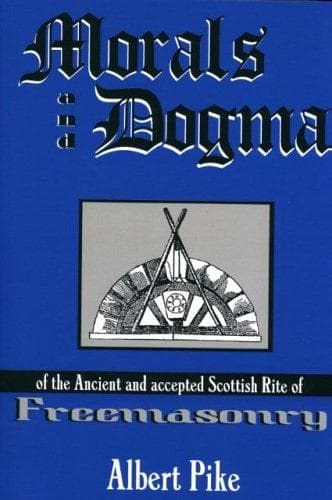
Morals and Dogma of the Ancient and Accepted Scottish Rite of FreemasonryPike, Albert
Religion
Morals and Dogma of the Ancient and Accepted Scottish Rite of Freemasonry
Pike, Albert
Freemasons
In the more frequent cases, where we have to join our efforts to those
of thousands of others, to contribute to the carrying forward of a great
cause; merely to till the ground or sow the seed for a very distant
harvest, or to prepare the way for the future advent of some great
amendment; the amount which each one contributes to the achievement of
ultimate success, the portion of the price which justice should assign
to each as his especial production, can never be accurately ascertained.
Perhaps few of those who have ever labored, in the patience of secrecy
and silence, to bring about some political or social change, which they
felt convinced would ultimately prove of vast service to humanity, lived
to see the change effected, or the anticipated good flow from it. Fewer
still of them were able to pronounce what appreciable weight their
several efforts contributed to the achievement of the change desired.
Many will doubt, whether, in truth, these exertions have any influence
whatever; and, discouraged, cease all active effort.
Not to be thus discouraged, the Mason must labor to elevate and purify
his _motives_, as well as sedulously cherish the conviction, assuredly a
true one, that in this world there is no such thing as effort thrown
away; that in all labor there is profit; that all sincere exertion, in a
righteous and unselfish cause, is _necessarily_ followed, in spite of
all appearance to the contrary, by an appropriate and proportionate
success; that _no_ bread cast upon the waters can be wholly lost; that
_no_ seed planted in the ground can fail to quicken in due time and
measure; and that, however we may, in moments of despondency, be apt to
doubt, not only whether our cause will triumph, but whether, if it does,
we shall have contributed to its triumph,--there is One, Who has not
only seen every exertion we have made, but Who can assign the exact
degree in which each soldier has assisted to gain the great victory over
social evil. No good work is done wholly in vain.
The Grand Elect, Perfect, and Sublime Mason will in nowise deserve that
honorable title, if he has not that strength, that will, that
self-sustaining energy; that Faith, that feeds upon no earthly hope, nor
ever thinks of victory, but, content in its own consummation, combats
because it ought to combat, rejoicing fights, and still rejoicing falls.
The Augean Stables of the World, the accumulated uncleanness and misery
of centuries, require a mighty river to cleanse them thoroughly away;
every drop we contribute aids to swell that river and augment its force,
in a degree appreciable by God, though not by man; and he whose zeal is
deep and earnest, will not be over-anxious that his individual drops
should be distinguishable amid the mighty mass of cleansing and
fertilizing waters; far less that, for the sake of distinction, it
should flow in ineffective singleness away.
Public-domain text, read in full here on John Shaqi.
Reviews
Reviews
No reviews yet
Be the first to share your thoughts on this work.
Elsewhere in the archive
Join the Discussion
Join the discussion
Sign in to leave a comment or review.
Sign InorCreate an account