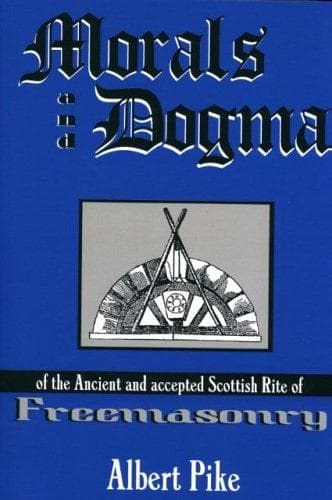
Morals and Dogma of the Ancient and Accepted Scottish Rite of FreemasonryPike, Albert
Religion
Morals and Dogma of the Ancient and Accepted Scottish Rite of Freemasonry
Pike, Albert
Freemasons
As the Ancients did, Masonry styles Temperance, Fortitude, Prudence, and
Justice, the four cardinal virtues. They are as necessary to nations as
to individuals. The people that would be Free and Independent, must
possess Sagacity, Forethought, Foresight, and careful Circumspection,
all which are included in the meaning of the word Prudence. It must be
temperate in asserting its rights, temperate in its councils, economical
in its expenses; it must be bold, brave, courageous, patient under
reverses, undismayed by disasters, hopeful amid calamities, like Rome
when she sold the field at which Hannibal had his camp. No Cannæ or
Pharsalia or Pavia or Agincourt or Waterloo must discourage her. Let her
Senate sit in their seats until the Gauls pluck them by the beard. She
must, above all things, be just, not truckling to the strong and warring
on or plundering the weak; she must act on the square with all nations,
and the feeblest tribes; always keeping her faith, honest in her
legislation, upright in all her dealings. Whenever such a Republic
exists, it will be immortal: for rashness, injustice, intemperance and
luxury in prosperity, and despair and disorder in adversity, are the
causes of the decay and dilapidation of nations.
II.
THE FELLOW-CRAFT.
In the Ancient Orient, all religion was more or less a mystery and there
was no divorce from it of philosophy. The popular theology, taking the
multitude of allegories and symbols for realities, degenerated into a
worship of the celestial luminaries, of imaginary Deities with human
feelings, passions, appetites, and lusts, of idols, stones, animals,
reptiles. The Onion was sacred to the Egyptians, because its different
layers were a symbol of the concentric heavenly spheres. Of course the
popular religion could not satisfy the deeper longings and thoughts, the
loftier aspirations of the Spirit, or the logic of reason. The first,
therefore, was taught to the initiated in the Mysteries. There, also, it
was taught by symbols. The vagueness of symbolism, capable of many
interpretations, reached what the palpable and conventional creed could
not. Its indefiniteness acknowledged the abstruseness of the subject: it
treated that mysterious subject mystically: it endeavored to illustrate
what it could not explain; to excite an appropriate _feeling_, if it
could not develop an adequate _idea_; and to make the image a mere
subordinate conveyance for the conception, which itself never became
obvious or familiar.
Thus the knowledge now imparted by books and letters, was of old
conveyed by symbols; and the priests invented or perpetuated a display
of rites and exhibitions, which were not only more attractive to the eye
than words, but often more suggestive and more pregnant with meaning to
the mind.
Public-domain text, read in full here on John Shaqi.
Reviews
Reviews
No reviews yet
Be the first to share your thoughts on this work.
Join the Discussion
Join the discussion
Sign in to leave a comment or review.
Sign InorCreate an account