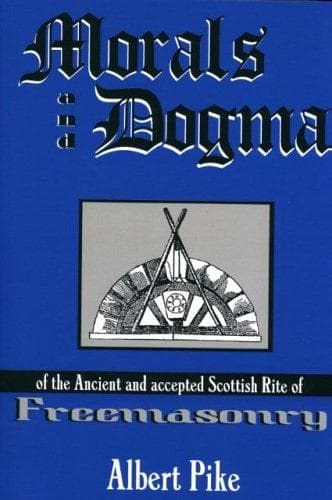
Morals and Dogma of the Ancient and Accepted Scottish Rite of FreemasonryPike, Albert
Religion
Morals and Dogma of the Ancient and Accepted Scottish Rite of Freemasonry
Pike, Albert
Freemasons
Masonry, successor of the Mysteries, still follows the ancient manner of
teaching. Her ceremonies are like the ancient mystic shows,--not the
reading of an essay, but the opening of a problem, requiring research,
and constituting philosophy the arch-expounder. Her symbols are the
instruction she gives. The lectures are endeavors, often partial and
one-sided, to interpret these symbols. He who would become an
accomplished Mason must not be content merely to hear, or even to
understand, the lectures; he must, aided by them, and they having, as
it were, marked out the way for him, study, interpret, and develop these
symbols for himself.
* * * * *
Though Masonry is identical with the ancient Mysteries, it is so only in
this qualified sense: that it presents but an imperfect image of their
brilliancy, the ruins only of their grandeur, and a system that has
experienced progressive alterations, the fruits of social events,
political circumstances, and the ambitious imbecility of its improvers.
After leaving Egypt, the Mysteries were modified by the habits of the
different nations among whom they were introduced, and especially by the
religious systems of the countries into which they were transplanted. To
maintain the established government, laws, and religion, was the
obligation of the Initiate everywhere; and everywhere they were the
heritage of the priests, who were nowhere willing to make the common
people co-proprietors with themselves of philosophical truth.
Masonry is not the Coliseum in ruins. It is rather a Roman palace of the
middle ages, disfigured by modern architectural improvements, yet built
on a Cyclopæan foundation laid by the Etruscans, and with many a stone
of the superstructure taken from dwellings and temples of the age of
Hadrian and Antoninus.
Christianity taught the doctrine of FRATERNITY; but repudiated that of
political EQUALITY, by continually inculcating obedience to Caesar, and
to those lawfully in authority. Masonry was the first apostle of
EQUALITY. In the Monastery there is _fraternity_ and _equality_, but no
_liberty_. Masonry added that also, and claimed for man the three-fold
heritage, LIBERTY, EQUALITY, and FRATERNITY.
It was but a development of the original purpose of the Mysteries, which
was to teach men to know and practice their duties to themselves and
their fellows, the great practical end of all philosophy and all
knowledge.
Public-domain text, read in full here on John Shaqi.
Reviews
Reviews
No reviews yet
Be the first to share your thoughts on this work.
Join the Discussion
Join the discussion
Sign in to leave a comment or review.
Sign InorCreate an account