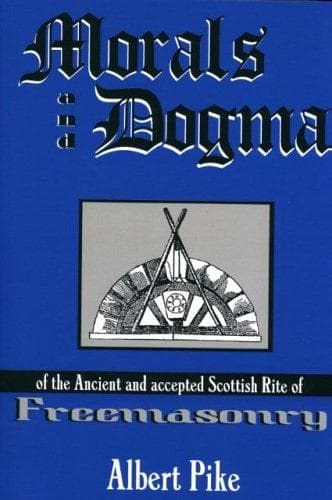
Morals and Dogma of the Ancient and Accepted Scottish Rite of FreemasonryPike, Albert
Religion
Morals and Dogma of the Ancient and Accepted Scottish Rite of Freemasonry
Pike, Albert
Freemasons
Do not expect easily to convince men of the truth, or to lead them to
think aright. The subtle human intellect can weave its mists over even
the clearest vision. Remember that it is eccentric enough to ask
unanimity from a jury; but to ask it from any large number of men on any
point of political faith is amazing. You can hardly get two men in any
Congress or Convention to agree;--nay, you can rarely get one to agree
with _himself_. The political church which chances to be supreme
anywhere has an indefinite number of tongues. How then can we expect men
to agree as to matters beyond the cognizance of the senses? How can we
compass the Infinite and the Invisible with any chain of evidence? Ask
the small sea-waves what they murmur among the pebbles! How many of
those words that come from the invisible shore are lost, like the birds,
in the long passage? How vainly do we strain the eyes across the long
Infinite! We must be content, as the children are, with the pebbles that
have been stranded, since it is forbidden us to explore the hidden
depths.
The Fellow-Craft is especially taught by this not to become wise in his
own conceit. Pride in unsound theories is worse than ignorance. Humility
becomes a Mason. Take some quiet, sober moment of life, and add together
the two ideas of Pride and Man; behold him, creature of a span, stalking
through infinite space in all the grandeur of littleness! Perched on a
speck of the Universe, every wind of Heaven strikes into his blood the
coldness of death; his soul floats away from his body like the melody
from the string. Day and night, like dust on the wheel, he is rolled
along the heavens, through a labyrinth of worlds, and all the creations
of God are flaming on every side, further than even his imagination can
reach. Is this a creature to make for himself a crown of glory, to deny
his own flesh, to mock at his fellow, sprung with him from that dust to
which both will soon return? Does the proud man not err? Does he not
suffer? Does he not die? When he reasons, is he never stopped short by
difficulties? When he acts, does he never succumb to the temptations of
pleasure? When he lives, is he free from pain? Do the diseases not claim
him as their prey? When he dies, can he escape the common grave? Pride
is not the heritage of man. Humility should dwell with frailty, and
atone for ignorance, error and imperfection.
Public-domain text, read in full here on John Shaqi.
Reviews
Reviews
No reviews yet
Be the first to share your thoughts on this work.
Join the Discussion
Join the discussion
Sign in to leave a comment or review.
Sign InorCreate an account