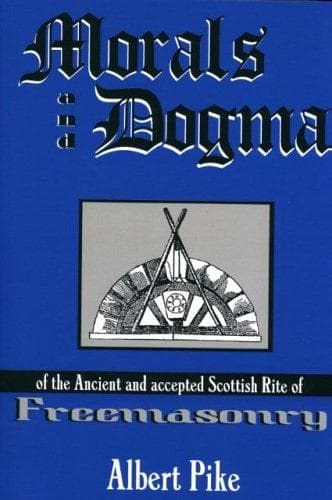
Morals and Dogma of the Ancient and Accepted Scottish Rite of Freemasonry — John Shaqi
Morals and Dogma of the Ancient and Accepted Scottish Rite of FreemasonryPike, Albert
Religion
Morals and Dogma of the Ancient and Accepted Scottish Rite of Freemasonry
Pike, Albert
Freemasons
Let no Fellow-Craft imagine that the work of the lowly and uninfluential
is not worth the doing. There is no legal limit to the possible
influences of a good deed or a wise word or a generous effort. Nothing
is really small. Whoever is open to the deep penetration of nature knows
this. Although, indeed, no absolute satisfaction may be vouchsafed to
philosophy, any more in circumscribing the cause than in limiting the
effect, the man of thought and contemplation falls into unfathomable
ecstacies in view of all the decompositions of forces resulting in
unity. All works for all. Destruction is not annihilation, but
regeneration.
Algebra applies to the clouds; the radiance of the star benefits the
rose; no thinker would dare to say that the perfume of the hawthorn is
useless to the constellations. Who, then, can calculate the path of the
molecule? How do we know that the creations of worlds are not determined
by the fall of grains of sand? Who, then, understands the reciprocal
flow and ebb of the infinitely great and the infinitely small; the
echoing of causes in the abysses of beginning, and the avalanches of
creation? A fleshworm is of account; the small is great; the great is
small; all is in equilibrium in necessity. There are marvellous
relations between beings and things; in this inexhaustible Whole, from
sun to grub, there is no scorn: all need each other. Light does not
carry terrestrial perfumes into the azure depths, without knowing what
it does with them; night distributes the stellar essence to the sleeping
plants. Every bird which flies has the thread of the Infinite in its
claw. Germination includes the hatching of a meteor, and the tap of a
swallow's bill, breaking the egg; and it leads forward the birth of an
earth-worm and the advent of a Socrates. Where the telescope ends the
microscope begins. Which of them the grander view? A bit of mould is a
Pleiad of flowers--a nebula is an ant-hill of stars.
Public-domain text, read in full here on John Shaqi.
Reviews
Reviews
No reviews yet
Be the first to share your thoughts on this work.
Join the Discussion
Join the discussion
Sign in to leave a comment or review.
Sign InorCreate an account