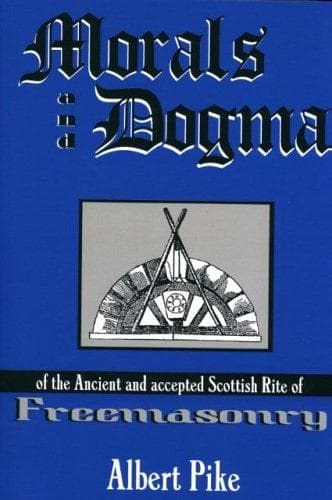
Morals and Dogma of the Ancient and Accepted Scottish Rite of FreemasonryPike, Albert
Religion
Morals and Dogma of the Ancient and Accepted Scottish Rite of Freemasonry
Pike, Albert
Freemasons
FAUST, with his types, or LUTHER, with his sermons, worked
greater results than Alexander or Hannibal. A single thought sometimes
suffices to overturn a dynasty. A silly song did more to unseat James
the Second than the acquittal of the Bishops. Voltaire, Condorcet, and
Rousseau uttered words that will ring, in change and revolutions,
throughout all the ages.
Remember, that though life is short, Thought and the influences of what
we do or say are immortal; and that no calculus has yet pretended to
ascertain the law of proportion between cause and effect. The hammer of
an English blacksmith, smiting down an insolent official, led to a
rebellion which came near being a revolution. The word well spoken, the
deed fitly done, even by the feeblest or humblest, cannot help but have
their effect. More or less, the effect is inevitable and eternal. The
echoes of the greatest deeds may die away like the echoes of a cry among
the cliffs, and what has been done seem to the human judgment to have
been without result. The unconsidered act of the poorest of men may fire
the train that leads to the subterranean mine, and an empire be rent by
the explosion.
The power of a free people is often at the disposal of a single and
seemingly an unimportant individual;--a terrible and truthful power; for
such a people feel with one heart, and therefore can lift up their
myriad arms for a single blow. And, again, there is no graduated scale
for the measurement of the influences of different intellects upon the
popular mind. Peter the Hermit held no office, yet what a work he
wrought!
* * * * *
From the political point of view there is but a single principle,--the
sovereignty of man over himself. This sovereignty of one's self over
one's self is called LIBERTY. Where two or several of these
sovereignties associate, the State begins. But in this association there
is no abdication. Each sovereignty parts with a certain portion of
itself to form the common right. That portion is the same for all. There
is equal contribution by all to the joint sovereignty. This identity of
concession which each makes to all, is EQUALITY. The common right is
nothing more or less than the protection of all, pouring its rays on
each. This protection of each by all, is FRATERNITY.
Liberty is the summit, Equality the base. Equality is not all vegetation
on a level, a society of big spears of grass and stunted oaks, a
neighborhood of jealousies, emasculating each other. It is, civilly, all
aptitudes having equal opportunity; politically, all votes having equal
weight; religiously, all consciences having equal rights.
Equality has an organ;--gratuitous and obligatory instruction. We must
begin with the right to the alphabet. The primary school _obligatory_
upon all; the higher school _offered_ to all. Such is the law. From the
same school for all springs equal society. Instruction! Light! all comes
from Light, and all returns to it.
Public-domain text, read in full here on John Shaqi.
Reviews
Reviews
No reviews yet
Be the first to share your thoughts on this work.
Join the Discussion
Join the discussion
Sign in to leave a comment or review.
Sign InorCreate an account