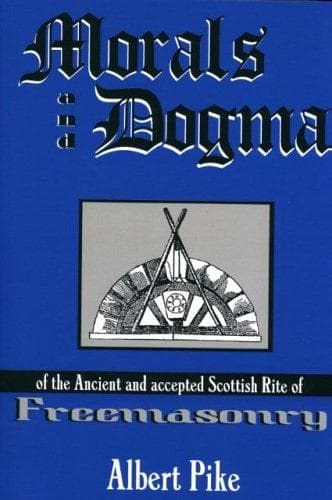
Morals and Dogma of the Ancient and Accepted Scottish Rite of FreemasonryPike, Albert
Religion
Morals and Dogma of the Ancient and Accepted Scottish Rite of Freemasonry
Pike, Albert
Freemasons
We must learn the thoughts of the common people, if we would be wise and
do any good work. We must look at men, not so much for what Fortune has
given to them with her blind old eyes, as for the gifts Nature has
brought in her lap, and for the use that has been made of them. We
profess to be equal in a Church and in the Lodge: we shall be equal in
the sight of God when He judges the earth. We may well sit on the
pavement together here, in communion and conference, for the few brief
moments that constitute life.
A Democratic Government undoubtedly has its defects, because it is made
and administered by men, and not by the Wise Gods. It cannot be concise
and sharp, like the despotic. When its ire is aroused it develops its
latent strength, and the sturdiest rebel trembles. But its habitual
domestic rule is tolerant, patient, and indecisive. Men are brought
together, first to differ, and then to agree. Affirmation, negation,
discussion, solution: these are the means of attaining truth. Often the
enemy will be at the gates before the babble of the disturbers is
drowned in the chorus of consent. In the Legislative office deliberation
will often defeat decision. Liberty can play the fool like the Tyrants.
Refined society requires greater minuteness of regulation; and the steps
of all advancing States are more and more to be picked among the old
rubbish and the new materials. The difficulty lies in discovering the
right path through the chaos of confusion. The adjustment of mutual
rights and wrongs is also more difficult in democracies. We do not see
and estimate the relative importance of objects so easily and clearly
from the level or the waving land as from the elevation of a lone peak,
towering above the plain; for each looks through his own mist.
Abject dependence on constituents, also, is too common. It is as
miserable a thing as abject dependence on a minister or the favorite of
a Tyrant. It is rare to find a man who can speak out the simple truth
that is in him, honestly and frankly, without fear, favor, or affection,
either to Emperor or People.
Moreover, in assemblies of men, faith in each other is almost always
wanting, unless a terrible pressure of calamity or danger from without
produces cohesion. Hence the constructive power of such assemblies is
generally deficient. The chief triumphs of modern days, in Europe, have
been in pulling down and obliterating; not in building up. But Repeal is
not Reform. Time must bring with him the Restorer and Rebuilder.
Public-domain text, read in full here on John Shaqi.
Reviews
Reviews
No reviews yet
Be the first to share your thoughts on this work.
Join the Discussion
Join the discussion
Sign in to leave a comment or review.
Sign InorCreate an account