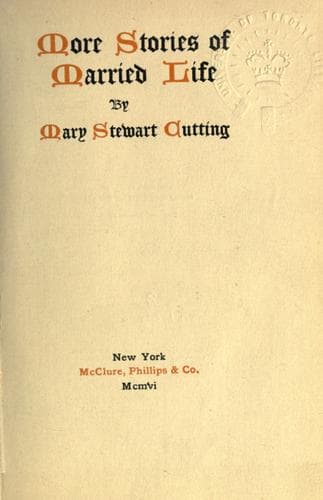
Married people -- United States -- Fiction; United States -- Social life and customs -- 20th century -- Fiction
“Yes,” said Mrs. Gibbons, raising her blue and guileless eyes to his. “I
didn’t know it was going so soon. I was looking for my husband.”
The policeman’s face changed from solicitude to the cheerful acceptance
of a familiar situation.
“Give ye the slip, did he? A lady like you, too! Sure he’s the bad lot,
and not wort’ your lookin’ for. Now don’t be frettin’ yourself, the Queen
couldn’t be safer. I’m wid you till the car comes. ’Tis an hour away.”
“It’s very good of you,” said Mrs. Gibbons, gratefully.
Of all the chances and changes of this wild Walpurgis night, there
could be nothing stranger than this, that she, Nita Gibbons, should be
sitting alone amid the dark marshes, in front of a Jersey “gin-mill,”
at half-past two o’clock in the morning. It was so entirely past all
imagining that frenzy had left her. She would probably never get
home again, but she had ceased to struggle against fate. She sat
there instead, passive, her slight figure bent against the cold night
wind, and her hair half falling down under her battered hat, looking
dreamily at the late twinkling stars in the black sky, and the gloomy
car-house opposite, and at the policeman who walked up and down
through the shadows. He swayed a little unsteadily, but he represented
the guardianship of the law. Once he came close to her and asked
encouragingly, “Would ye like a doggy?”
“What kind?” said Mrs. Gibbons, with a hazy fear of too large a
protective animal.
He pointed over his shoulder towards the stationary light down the road.
“The kind they do be havin’ in the Owl Wagon, down there—frankfooties or
doggies, ’tis the same. I could get ye wan, wid a roll; they’re cleaned
out in the s’loon here.”
“Thank you, I’d rather not eat,” said Mrs. Gibbons in haste, and then
started nervously as the noise of footsteps running broke upon the ear.
The three men who had followed the thief came in sight from the direction
in which they had fled from the car. One called out, “Good-night, I’m
going to hoof it home!”
And another voice also called, “Glad you got your pocketbook back
again—ought to have got the fellow, too.”
The third said nothing, as he came towards the platform. Mrs. Gibbons
turned her head away. The next instant a voice of amazement said,
“_Nita!_ You here!” and, looking up, she saw her husband.
“Oh, Arnold, Arnold!” She stopped short in view of his face. “Oh, Arnold,
I don’t wonder you’re surprised to see me, dear, but I’ve been looking
for you!”
“Looking for _me_! Nita! _Nita!_ NITA!”
The astonishment in his voice held something ominous in it. She clung to
his arm with both hands, as she rose with him, and hardly realized, in
her excited explaining and explaining, that she was being borne off down
the road without waiting for the car, at a tremendous pace, and still
spasmodically explaining to a portentous silence. When he spoke at last
it was in a tone that sounded dangerous:
“So the Worthingtons went off and _left_ you?”
Public-domain text, read in full here on John Shaqi.
Reviews
Reviews
No reviews yet
Be the first to share your thoughts on this work.
Join the Discussion
Join the discussion
Sign in to leave a comment or review.
Sign InorCreate an account