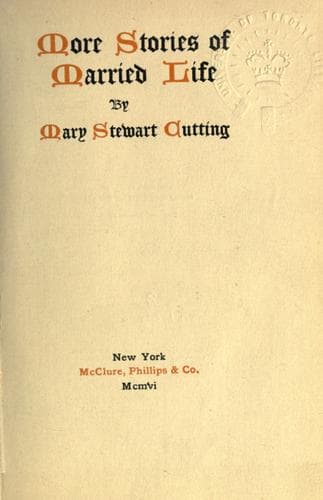
Married people -- United States -- Fiction; United States -- Social life and customs -- 20th century -- Fiction
“Oh, I’ve had such a horrid, horrid, horrid time!” The tears were
blinding her so that she leaned unseeing on the enfolding arm that
guided her. “I don’t mind your scolding me. I’m not crying for _that_.
I don’t mind anything you say. I don’t mind even your not having kissed
me. Nothing makes any difference to me as long as it’s you. I’m crying
because I’m so glad it’s you, and I can hear your voice again. When I
was trying to find you it seemed as if it would never end; it seemed—it
seemed——” She raised her wet eyes to his.
He took a swift look up and down the empty, lifeless street, laid out
straight and stiff in the cold, faint glimmer of the dawn, and then his
lips sought hers in deep, deep acknowledgment of the joy, and of the
sorrow, to which all love is born—one of those moments stolen in its
beautifulness from the life to come.
But his voice was tense again, as he set her down within her own doorway,
and he looked at her with stern eyes of jealous care, from which she hid
the woman’s smile of love at dear love’s unreason.
“You’re nearly _dead_! Don’t you stir out of this house to-morrow until I
come home—do you hear? _Never_ surprise me again!”
At the Sign of the Rubber Plant
“I wonder _what_ he meant!”
Mrs. Thatcher had risen from the breakfast table from which her husband
had departed some time since, after throwing out a mysterious hint about
some event in store for her. She had better look out for—what? He had
gone before she could question him further.
She went to the front window now, gazing down the street after Bobby, her
only child, on his way to the kindergarten. She was a very tall young
woman, yet lost none of her femininity by her height; it seemed rather
to emphasize it in a willowy droop that always suggested an appealing
dependence, in connection with the upward glance of her dark eyes. Her
hair was dark, like her eyes, and very thick; her lips were red and
curved; her cheeks were usually pale, but there was a faint glow on them
now. Nevin had made a terse but complimentary remark about her appearance
in that blue cambric morning dress, which she had received with as much
innocent surprise as if she had not planned for it. He had also said that
he pitied that poor fellow next door whose wife was homely enough to
take away his appetite.
Mr. Thatcher’s attitude towards his wife was the subject both of
good-natured comment and raillery among her neighbours. His least action
towards her was charged, though unobtrusively, with that subtle and
intimate attention which one only expects from a lover. He even had a
way of helping her up and down the steps that was “different” to the
married eye. Patently unintellectual as Mildred Thatcher was, she yet
indisputably retained her charm for the man who _was_ intellectual. She
had, in fact, that sweet will to be beloved which instinctively foreruns
occasion, and makes a place for it in all the little daily matters of
life.
Public-domain text, read in full here on John Shaqi.
Reviews
Reviews
No reviews yet
Be the first to share your thoughts on this work.
Join the Discussion
Join the discussion
Sign in to leave a comment or review.
Sign InorCreate an account