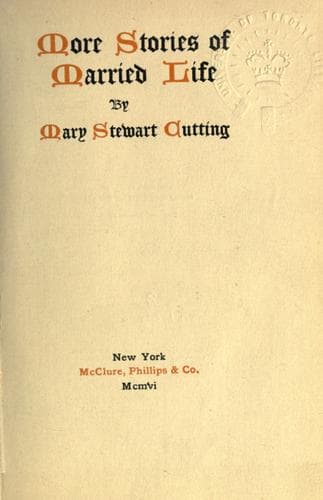
Married people -- United States -- Fiction; United States -- Social life and customs -- 20th century -- Fiction
“I wonder what he meant! I feel exactly as if somebody would come out
from town to-day—it’s such a lovely morning.” She spoke half aloud as
she looked down the street through the green feathery foliage of the
elms, just out in their spring dress. The sun shone caressingly through
them upon the crocuses peeping out in the front grass-plot, and the air,
delicately cool, was charged with perfume. There were all the usual
adjuncts of spring in the suburbs. A department store wagon was already
delivering parcels at a house further down, and several women, fresh
and neatly gloved, were alertly stepping trainward to get an early start
for the day’s shopping, impelled thither by that soft breeze which woos
womankind to the pursuit of clothes. All down the block the palms and
rubber plants were being sunned on piazza steps, the former, for the most
part, conspicuously brown and withered, but the latter still chunkily
green after a winter of furnace heat and dust and gas.
To feel the spring air and not want to spend money was impossible even to
Mildred Thatcher, but even if she could have purchased the rug so badly
needed for the little drawing-room she would not leave home to-day. She
was sure some one would be out from town. She turned now to the maid and
gave her orders for luncheon.
“You can make the cold meat into croquettes, Kitty, and we’ll have
pop-overs. And I’d like you to wash out the violet centerpiece.”
“Very well, ma’am.”
The hint of a pending pleasure had set its seal on the day. It might be
Madge Stanfield who would come, or the Laviers, or her Cousin Lou. She
set things to rights, and dusted and arranged daintily, and put fresh
violets in the glass vases, and by and by, late in the morning, when all
was done, went out on the piazza to listen for the train, while deciding
whether or no to send her dwindling palms to the florist. She scrutinized
the rubber plant anxiously for some sign of growth. The rubber plant
was, in a way, a proof of the demoralizing extremes of Mildred’s nature.
For a season she had railed intemperately at rubber plants and their
possessors, and then, after moving from a flat to the suburbs, had
incontinently gone forth one morning on the spur of the moment and bought
one. It somehow didn’t seem as if they were really householders without
that green and visible emblem of a much-enduring domesticity. Mrs.
Thatcher cherished an idea that her rubber plant would grow with tropical
luxuriance, but as yet it had only remained stolidly green.
“Good-morning!”
It was a neighbour, who, deflecting from the pavement, came up, with a
paper bag in one hand, to lean familiarly against the post at the foot of
the low steps.
“Your plants need water,” she continued, casting an officially critical
eye upon them.
“They were watered this morning,” said Mrs. Thatcher.
Public-domain text, read in full here on John Shaqi.
Reviews
Reviews
No reviews yet
Be the first to share your thoughts on this work.
Join the Discussion
Join the discussion
Sign in to leave a comment or review.
Sign InorCreate an account