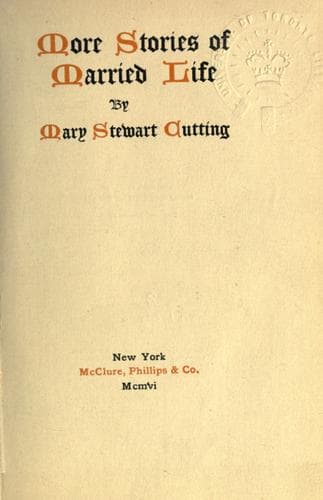
Married people -- United States -- Fiction; United States -- Social life and customs -- 20th century -- Fiction
Brenner was sitting now cross-legged on the sofa, strumming obliviously
on the banjo, while Prescott, his arms on the dining-table, leaned
towards Mrs. Brenner’s sympathy. Something in this warm home atmosphere
was too much for him.
“She—I—there’re some things you can’t talk about, Mrs. Brenner. Now,
the other night my wife had to get up at two o’clock in the morning and
go out over the snow to the doctor’s; Martin, that’s my boy, was taken
sick. Little Emma wouldn’t let her mother go alone—she’s only nine. My
wife wrote me that it didn’t scare her a bit, but it does seem sort of
pitiful—doesn’t it?—to think of their doing it. It’s never happened
before, but the neighbours we used to have moved away.”
“Oh, you mind it more than she would,” said Mrs. Brenner encouragingly.
Her soft eyes made a temporary home for him.
“Things seem to tell on her more than they used, though she tries hard
not to let me see it. She’s always worrying about me, in this kind of
weather, for fear I’ll come down with something alone in a hotel. But my
wife”—Prescott paused a moment awkwardly—“my wife’s awfully _good_; I’m
not that way myself, Mrs. Brenner, but I don’t think I would care for a
woman that wasn’t religious. She thinks everything is _meant_. And it
helps her a lot.”
“Yes, I know,” said Mrs. Brenner. She added after a little silence: “Was
your boy very ill?”
“Ill? No; he was all right the next day. But she caught cold; she
doesn’t think enough of herself; she’s that kind, you know. It’s clear
foolishness! Last time I was home I found that when the girl left—we
had one for six years and have been changing hoodlums every fifteen
minutes since she married—well, when the last one left I found she’d been
carrying up the coal for the fires because the boy got tired, and she was
afraid it would hurt him. Husky little beggar, I’d tire him all right!
He’s just getting to the age when he’s too much for his mother—nothing
wrong about him, but he worries her. He slings his books at the brakemen
when he goes in to school on the train and gets complained of—and he
smokes cigarettes around the corner and the neighbours come and tell her,
and it breaks her all up.”
“He needs a man,” said Mrs. Brenner.
“Yes. But you see I’m home so seldom she can’t bear to have me down on
the children the only time I’m with them. You see, a man doesn’t think
much whether he likes to travel or not—it’s just something that’s got to
be done, if you’re in the business—but it’s hard on a woman. Some women
seem to get used to it, though.”
“Ah,” murmured Mrs. Brenner, “when we married I said to my husband: ‘When
I get over caring for you, then I’ll get over minding your leaving me—and
not before.’”
“Why, that’s what my wife says!” said Prescott. He laughed, with a rising
colour, and shook his head. “You women—you’re all alike. You don’t know
what lots of good it’s done me to be here and talk to you to-night; it’s
most as good as being home—not quite, though.”
Public-domain text, read in full here on John Shaqi.
Reviews
Reviews
No reviews yet
Be the first to share your thoughts on this work.
Join the Discussion
Join the discussion
Sign in to leave a comment or review.
Sign InorCreate an account