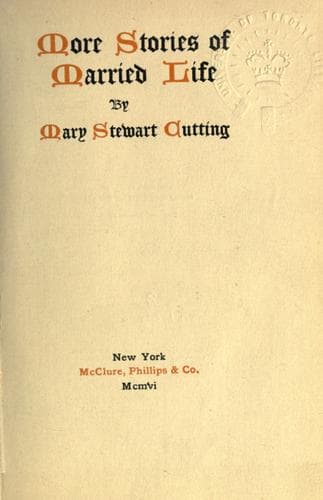
Married people -- United States -- Fiction; United States -- Social life and customs -- 20th century -- Fiction
“Can’t you stop travelling?” said Mrs. Brenner, going with penetrative
instinct to the thought she felt. She added, after a pause: “Are you sure
you can’t?”
He looked at her uncertainly. “How did you know that? No, I’m not sure I
can’t—but I’m not sure I can. And I’m not so young as I was.”
“Think of it.” Her hand gave his a warm clasp; through her eyes he saw
his wife. “_Think_ of it.”
“God knows I do,” said Prescott huskily. His hand wrenched hers in its
farewell, before he put on the overcoat Brenner brought him from the back
hall.
All the way back to the hotel he was thinking over things. It all
depended on that few hundred dollars extra, so absolutely necessary that,
without it, he could not provide a shelter for his family. More than a
living he no longer planned for. He looked at the future with the eye of
the man who, whatever his abilities, has come to learn that, either from
early training, or environment, or the iron bands of need, more than a
careful living can never be his. He could have enjoyed riches as well and
more than many another man, but they were so out of all calculation that
what they could buy no longer aroused in him any particular interest. He
would never even be able to indulge in that pathetically ludicrous dream
of the business man of retiring to a green and placid land and raising
catalogue produce from theory. He would be able to save little, after
educating his children, but the money to pay the insurance that would
keep his wife from penury when he died. For all his days he must work in
harness, and take no holiday but that which Death gives to the great rank
and file.
Yet, in spite of these limitations, for all that he tacitly renounced, he
had good measure. He had the freedom of spirit which belongs to him who,
given a competence, envies not any man his wealth or his opportunity.
He had gained a capacity for getting great and far-reaching happiness
from the exquisite little joys of life. If he had a little of the inner
sadness that comes of foregoing the ambitions natural to a man, it was
not the sadness of defeat, but rather the thoughtful weighing of the
loss as the least—all things considered—that he could have had. In the
silent times of those long journeyings by day and night over the earth,
the pricelessness of the common blessing of a home had sunk deeper and
deeper into his soul. And the spring of all this was in the love he and
his wife had for each other, a love that was too much of a vital power to
be consciously dwelt upon; it was rather an enlarging and enriching of
the whole nature because they two were one in the possession of a country
which it is given to but few of the married to see even afar off. Below
all trouble lay ever a secret joy; whither he went, she companied him. In
all the years of separation, they were less apart than many whose hands
meet daily; there could be no real separation between them even after
death.
Public-domain text, read in full here on John Shaqi.
Reviews
Reviews
No reviews yet
Be the first to share your thoughts on this work.
Join the Discussion
Join the discussion
Sign in to leave a comment or review.
Sign InorCreate an account