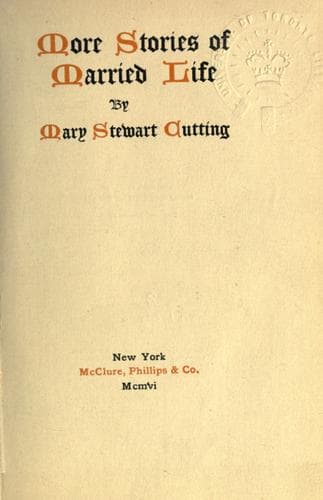
Married people -- United States -- Fiction; United States -- Social life and customs -- 20th century -- Fiction
But now—but now—she was getting tired. Her small face with its pure
outlines, the sweet, nervous mouth and the loving eyes came before
him—her low controlled voice, her quick motions, her rapid adjustment
of all domestic problems that his brief stay at home might be bright
and restful, the children at their best, the meals most home-like, and
she herself dressed prettily, with the work so ordered that she might
not lose a minute of his society. If callers came on one of those
precious afternoons, she rebelled as if at a calamity. She had always
been so brave, so helpful, but she was not so strong as she had been,
and the boy was too much for her. If he could but see his way a little
clearer! He had the cautiousness of methods new to him that comes of the
inexperience of manhood, far more frustrating than the inexperience of
the boy.
Brenner came around the next day just before train time.
“Mame sent me,” he explained. “She’s been talking to me ever since you
left. She’s got a brother in New York who’s in the line you’re looking
up, and she has an idea you can fix up something with him in connection
with the position you were telling me of. If you can carry some of his
business with you I don’t see but it would help you out mighty well.
He’s a good man—and he’ll do anything for Mame, if he _can_ do it. She’s
written him a letter, and here’s one for you.”
“I’m much obliged, I’m sure,” said Prescott politely. He did not speak
with enthusiasm; he had a rooted distaste for a woman’s intervention in
business matters, and by daylight his evening confidences rather annoyed
him. Still——
“A telegram for you, sir,” said a boy, coming up.
Prescott took it and opened it mechanically. He stood for a moment with
his eyes glued to the paper, and when he looked up Brenner cried in
horror:
“Not your _wife_, man!”
“No,” said Prescott thickly. “It’s little Margaret.” He consulted the
paper. “She’s not dead—yet. She’s been run over. She may not be so badly
hurt as they fear. My God! I can’t get there for two days!”
“Thank heaven the east-bound train’s on time,” said Brenner devoutly, and
went home to be cheered by his Mame.
* * * * *
“Papa is to carry little Margaret up-stairs—think of it!—dear papa to
carry her—such a treat! His arms are so much stronger than mamma’s.” It
was a week since the day of the telegram.
“Mamma jiggles,” said the child roguishly, looking backward from the
shelter of her father’s arms to the slender figure toiling up laboriously
with shawls and pillows. “Mamma carries Marget all slippy.”
“Poor mamma,” said the father; “she has to do everything when I’m not
here.” He pressed his lips to the soft baby cheek of the little girl who
was getting well, but his thought was with the mother. “Now what on earth
are you lugging all those things up for, Annie? Didn’t I tell you to
call Martin to take them? You know you’re all worn out.”
“He’s reading, and I thought I wouldn’t disturb him.”
Public-domain text, read in full here on John Shaqi.
Reviews
Reviews
No reviews yet
Be the first to share your thoughts on this work.
Join the Discussion
Join the discussion
Sign in to leave a comment or review.
Sign InorCreate an account