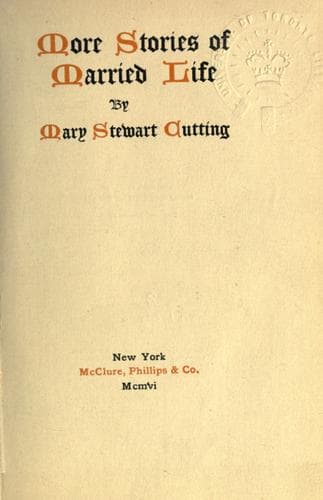
Married people -- United States -- Fiction; United States -- Social life and customs -- 20th century -- Fiction
“No indeed,” corroborated Mrs. Ranney. She followed the group of women
who hovered towards the kitchen a moment later, her large, flower-blue
eyes bent earnestly upon them. “What is it you were just saying, Mrs.
Spicer? No, I don’t think you’d better undress the children. I’ll just
let them sleep as they are, after slipping off their shoes; they’re so
tired. Mr. Ranney and Minda will carry them up-stairs. Please, Mrs.
Stone, don’t get any coffee for us—it’s just as _kind_—I appreciate all
the trouble you’ve taken, but we had dinner at the Astor House before
we came out; we couldn’t eat a thing now. And would you mind not saying
anything more about the voyage? My husband doesn’t like to talk about it.
I think a good night’s rest is what we all need.”
“Well, it’s evident they’ve no more use for _us_,” said Mrs. Stone with
a sigh of acquiescence as the sympathizers stood once more without the
portals; the position was felt to be symbolic, yet after the first
bewildered drop from exaltation there was only a faint offense left. Mrs.
Stone voiced the general sentiment as she continued:
“There’s one thing certain, Mr. Ranney will never forget these last six
weeks; I don’t care how he _talks_, he can’t keep his eyes off her face.
He has found out what his wife is, at last.”
So deep was this feeling of certainty, that almost an electric,
shuddering wave of horror passed over the Ridge the next evening when Mr.
Ranney, natty and immaculate, his gold-banded yachting cap on the side
of his head, pipe in hand, swung jauntily out of his front gate into the
broad, white moonlight that lay along the street. Only Mrs. Laurence,
from the contradictory evidence of her own deep love, had a sudden,
sweet, half-smile-and-tearful divination, that he hadn’t had the heart
for freedom before, with his wife away. Her dear presence now was so
pervasive that the whole town seemed like home to him because she was in
it.
A Symphony in Coal
A Symphony in Coal
“Did you order the coal for the furnace yesterday?”
“No, by George! I forgot it.” Mr. Laurence half paused, his tall figure
arrested in the act of putting on his overcoat in the front hall, to
which his wife had followed him, napkin in hand, from the breakfast table.
“Oh, _Will_! and I told you the day before, so that you’d have plenty of
time.” Mrs. Laurence’s brows expressed tragic disappointment, her tone,
if affectionate, was despairing. “I never saw any one like you, you never
remember a thing I ask you to, any more. You don’t seem to have a mind
for anything but that old law business. You’ll _have_ to order the coal
this morning.”
“But, Nan”—Mr. Laurence, with his overcoat on and hat in hand, bent his
fine, thin face over his watch. “I don’t see how I can, possibly; I’ve an
appointment in town, and I must go around by Herkimer Street on my way to
the station to see if Lalor’s got the papers he promised me.”
“I thought you were going there to-night.” Mrs. Laurence held the
door-knob fast.
Public-domain text, read in full here on John Shaqi.
Reviews
Reviews
No reviews yet
Be the first to share your thoughts on this work.
Join the Discussion
Join the discussion
Sign in to leave a comment or review.
Sign InorCreate an account