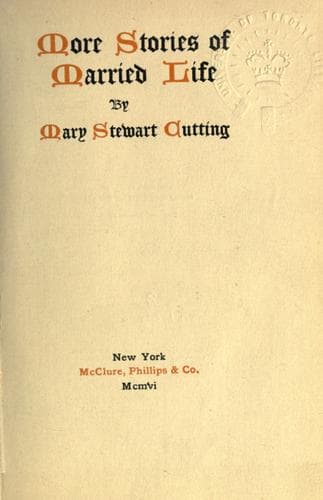
Married people -- United States -- Fiction; United States -- Social life and customs -- 20th century -- Fiction
“I am, but I want the papers first. Couldn’t you send one of the maids to
order the coal?”
“Yes, I could, but I won’t,” said his wife. Her dark eyes flashed, her
tone had the conscious defiance of the loved woman, who can trade on her
charm enough to be belligerent if she feels like it. “It’s got to the
place where I see to every single article we eat or wear or use in this
house _but_ the coal! And I just won’t order that. I told you about it
three days ago and we _must_ have it this morning, with all this snow on
the ground, whether it makes you late for your appointment or not.”
“Then let me go now,” said Mr. Laurence tersely, putting aside the arms
with which she sought to encircle him as he swooped hastily over to kiss
her on his way out. The open door let in a rush of cold air, as almost
visibly keen and sparkling as a scimitar, that clove the lungs for a
moment, before it was closed behind him, and his wife went back to the
breakfast table where her ten-year-old son awaited her to glean the
information about his history lesson which he should have looked up for
himself the day before. It was, perhaps, the trouble with Mrs. Laurence
that her brightness and her intelligence served to help only by taking
the whole burden of a thing upon herself; it might be indeed the reason
why Mr. Laurence’s official duties in the household had dwindled down
to the ordering of coal, and the minor courtesy of getting a glass of
water for her himself before she went to bed; it might be because she
had never been able to see him do anything without doing it too. In the
days when he had ostensibly locked up for the night she always followed
around after him to see that the windows and doors were really bolted, so
that gradually he left it all to her; if he poked the fire she snatched
up the poker from where he had laid it to do the work over again. If he
were sitting down she carried her own chair near the lamp rather than
draw his attention to her need. Yet, sometimes, she had begun to have
a little hurt feeling that he let her do so much. As to this matter of
the coal—she could have sent Teresa to Harner’s, of course—it was before
that revelling era of house-to-house telephoning on the Ridge—yet even
at the thought she stiffened a little. There are certain unnoticed beams
and girders that hold up an edifice; if one of these is out of plumb the
whole building sags.
If Will really refused to order the coal he couldn’t be quite her Will
any more.
Public-domain text, read in full here on John Shaqi.
Reviews
Reviews
No reviews yet
Be the first to share your thoughts on this work.
Join the Discussion
Join the discussion
Sign in to leave a comment or review.
Sign InorCreate an account