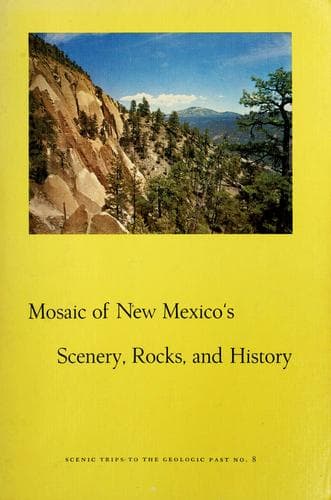
Mosaic of New Mexico's Scenery, Rocks, and History
History
Mosaic of New Mexico's Scenery, Rocks, and History
Geology -- New Mexico; New Mexico -- Description and travel; New Mexico -- History
People entering New Mexico today find Indian cultures and Indian
villages with traditions and ways of life that have changed little in
many centuries. In this respect, man in the twentieth century shares an
experience in common with Coronado, Oñate, and all the other
_conquistadores_ who visited New Mexico so many generations ago. They,
too, found the ancient Indian cultures strangely magnetic and exciting.
If we could but remove the asphalt highways, the billboards, the
telephone poles, and fences that seem always to surround us, the Indian
villages in many parts of the state would look very much as they looked
to the early Spanish explorers who were the first Europeans to see them.
To meet the Indians of New Mexico and to visit their homes, if possible,
is one of the greatest experiences available to residents and visitors
alike. Although words are inadequate to give the true flavor and
excitement of the Indian and his way of life, they are all we have to
introduce the various people who make up the Indian population of New
Mexico.
There are two main groups that should be known. First, the Pueblo
Indians, those who developed sedentary village life and who are the
descendants of the first Americans in New Mexico. Second, the
“newcomers” to the state, those who, for some reason or other, moved
into the state to replace earlier cultures. Let us, then, visit some of
these people’s homes.
Acoma Pueblo
Acoma Indian Pueblo, the Sky City, is famous in both history and legend.
Built on the top of a lofty, almost inaccessible, redrock mesa some 357
feet high, it is one of the most picturesque of all New Mexico Indian
pueblos. No other pueblo gives one such a clear sense of living in
ancestral times. The movements of the people up and down the steep
trails, the untiring vistas, and the ancient homesites are reminiscent
of the life and times of the cliff dwellers. Here the archeologists can
search out the secrets of ancient life by direct observation. Here, too,
is brought forth in the fullness of its bloom an Indian culture of
outstanding achievement.
The Indians of Acoma participated in the great Pueblo Revolt of 1680.
They killed their priest, Fray Lucas Maldonado, in the first frenzy of
the rebellion. Because of their isolation and the inaccessibility of the
village, they were spared the vengeance of the Spaniards under de Vargas
during the reconquest in 1692. There was an attempt by the Spanish in
1696 to take Acoma, but they succeeded only in destroying the crops and
in capturing five Acoma warriors. The Indians held out until July 6,
1699, when they submitted to the Spanish governor of New Mexico,
Governor Cubero. Thereafter, Acoma became an integral part of the
mission complex established in New Mexico by the Spanish.
[Illustration: (_Forest Service, U.S.D.A., by Starr Jenkins_)
Aspen Basin in Sangre de Cristo Mountains near Santa Fe]
Public-domain text, read in full here on John Shaqi.
Reviews
Reviews
No reviews yet
Be the first to share your thoughts on this work.
Elsewhere in the archive
Join the Discussion
Join the discussion
Sign in to leave a comment or review.
Sign InorCreate an account