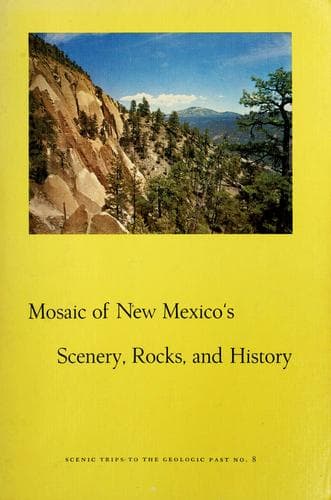
Mosaic of New Mexico's Scenery, Rocks, and History
History
Mosaic of New Mexico's Scenery, Rocks, and History
Geology -- New Mexico; New Mexico -- Description and travel; New Mexico -- History
[Illustration: (_Forest Service, U.S.D.A., by John Whiteside_)
Tent Rocks in Jemez Mountains]
Acoma is noted for its excellent pottery. The ware is fashioned from
clay of fine quality, is very well fired, and is carefully decorated in
typical Acoma designs. Here is an excellent example of Indian artistic
ability. Some weaving, such as belts and headbands, is engaged in and a
few baskets are produced, but Acoma is most famous for its pottery.
One of the landmarks at Acoma is the great church which brave Fray Juan
Ramirez toiled to create in the early seventeenth century. Surely there
are few memorials of the Spanish epoch in the Southwest that present
such a picture of dauntless faith in spiritual ideals as does this
fortress church silhouetted high against the sky above the bare-rock
mesa. It measures 150 feet in length and has walls that are 60 feet high
and 10 feet thick. Timbers 40 feet long and 14 inches through support
the roof and make a handsome ceiling. There are, of course, no seats and
little decoration. And what a location for so magnificent a spiritual
center it is! From there one may lift his eyes in rapt admiration of the
splendid panorama of the great plain and the encircling mountains, and
thereby appreciate more fully the work of the Deity.
The Acoma are agriculturists, cultivating their lands by irrigation;
they raise corn, wheat, melons, squashes, and hay. Now, however, most of
the people of Acoma do not live on their mesa which protected them for
so many centuries. The dangers of attack are no longer present, and the
farmers find it more advantageous to live closer to their irrigated
plots. The result is that the people of Acoma are now scattered
throughout several villages. Their great culture, their traditions,
their fierce pride, and their deep reverence for their spectacular
history is visible in their faces and manners. Acoma, the Sky City,
remains the eternal city of New Mexico.
Cochiti Pueblo
The Indians of Cochiti Pueblo claim the famed cave dwellings and ruins
of the Rito de Frijoles (Bandelier National Monument) as their ancestral
home. Failure of timber and water resources plus the constant attack of
the various Apache Indian tribes over several centuries caused the
residents of the Rito de Frijoles to seek a better home. This probably
occurred about 1200 A.D. In 1598, when Juan de Oñate, colonizer of New
Mexico, arrived, the Indians of Cochiti were living in their present
village. For a short time following the reconquest of New Mexico by de
Vargas after the Pueblo Revolt, the people of Cochiti lived in Cañada de
Cochiti, which was in a better position for defense against Spanish
reconquest. In 1694, de Vargas took the canyon village by storm, burned
it, and forced the people to return to the older village of Cochiti
where they remain to this day.
Public-domain text, read in full here on John Shaqi.
Reviews
Reviews
No reviews yet
Be the first to share your thoughts on this work.
Elsewhere in the archive
Join the Discussion
Join the discussion
Sign in to leave a comment or review.
Sign InorCreate an account