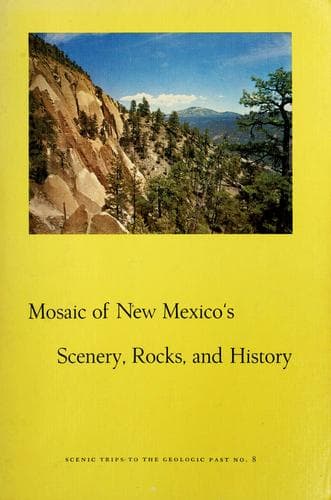
Mosaic of New Mexico's Scenery, Rocks, and History
History
Mosaic of New Mexico's Scenery, Rocks, and History
Geology -- New Mexico; New Mexico -- Description and travel; New Mexico -- History
The population of the village is slightly more than 300, and there has
been little growth in the past thirty years. Like the other New Mexico
pueblos, the main occupation is agriculture. Their ancient traditions
are well preserved, among them the well-known Rain Dance held during the
annual festival of San Buenaventura in July.
Located at the pueblo is the ancient and beautiful Spanish mission, San
Buenaventura de Cochiti, built in the early seventeenth century. To step
into this church is to return to the Spanish days of yore. There are no
seats, women kneel on one side, the men on the other, and the services
are a mixture of old world orthodoxy and new world Indian traditions.
Cochiti represents one of the finest examples of modern Pueblo Indian
life.
Isleta Pueblo
Isleta Pueblo is the southernmost of the pueblos lying along the green
and lush Rio Grande Valley today. It stands on the same site it occupied
when Coronado came in 1540 and was a stopping place for every Spanish
explorer and traveler who passed through New Mexico. It did not take
part in the Pueblo Revolt of 1680, but rather joined the Spanish in the
retreat to El Paso del Norte (modern Juarez, Mexico). There they founded
a new village just to the south of modern El Paso which they called
Isleta del Sur. The main village of Isleta, in New Mexico, remained
deserted until 1709 when it was re-established by Fray Juan de la Peña.
Two different missions were built at Isleta Pueblo. The first, San
Antonio de Isleta, was constructed about 1629. The church was burned in
1680, and in 1681 was being used as a sheep corral. Between 1680 and the
completion of the reconquest, it was completely destroyed. The second
mission, still remaining at Isleta, called San Agustin de Isleta, was
built in 1709 on the old site.
Agriculture is the primary pursuit of the Indians of Isleta, although
they do considerable stock grazing. The population of Isleta is nearly
2000 persons. The annual fiesta takes place in late August.
Jemez Pueblo
The Jemez Indians were first seen by Europeans in 1541 when they were
visited by Captain Francisco de Barrio-Nuevo, of Coronado’s expedition.
He counted seven villages, naming them Aguas Calientes because of the
many hot springs in the canyon of the Jemez River. The ancient pueblos
are now all in ruins, with one preserved as the Jemez State Monument.
The present pueblo, built on the mesa where the Jemez River leaves the
mountains, was constructed after the Pueblo Revolt. The Jemez people
fled their older villages during the reconquest and for a time lived
with the Navajo, whom they disliked but preferred to the Spanish.
Public-domain text, read in full here on John Shaqi.
Reviews
Reviews
No reviews yet
Be the first to share your thoughts on this work.
Elsewhere in the archive
Join the Discussion
Join the discussion
Sign in to leave a comment or review.
Sign InorCreate an account