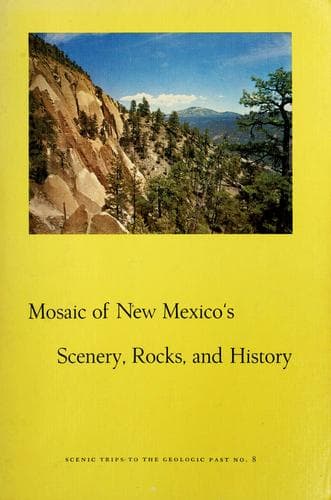
Mosaic of New Mexico's Scenery, Rocks, and History
History
Mosaic of New Mexico's Scenery, Rocks, and History
Geology -- New Mexico; New Mexico -- Description and travel; New Mexico -- History
There have been four notable missions among the Jemez Indians. The
first, San Diego de Jemez Mission, was built in the early seventeenth
century. It was one of the most successful of the New Mexico missions;
reportedly, more than 6000 converts were made among the Jemez Indians
before 1622. Because of the constant attacks of the Navajo, the
traditional enemies of the Jemez people, the ancient pueblos gradually
declined and were finally completely abandoned after Jemez participation
in the Pueblo Revolt. The ruins of this church, now the Jemez State
Monument, are among the most picturesque in all New Mexico. Its walls
are three feet thick and were put together with intricate care. In its
time, it must have been a beautiful building.
The second, San Juan de Los Jemez Mission, was built in 1617 at a
village located near the junction of the Guadalupe and Jemez rivers, six
miles north of the present pueblo. The ruins are faint but still
visible. The mission was abandoned in 1680.
The third mission had a very brief history. It was called San Jose de
los Jemez Mission and was located near San Juan de Los Jemez, of which
it was a _visita_. Like San Juan, San Jose was abandoned in 1680.
The present mission was founded early in the eighteenth century and is
one of the interesting things to visit at Jemez Pueblo. This old church
is the center of the annual festival held at Jemez on November 12.
Jemez is noted for its splendid presentation of the Buffalo Dance in the
winter and for its Corn Dances during the November festival.
Laguna Pueblo
Laguna Pueblo is the youngest and second largest of the pueblos in New
Mexico. Built in 1697, shortly after the reconquest by de Vargas, the
name was derived from a large lake which existed at one time just west
of the village. In addition to the main village, a number of small
settlements have developed where the terrain is suitable for
agriculture, the main occupation of the Lagunas. The most important of
these villages are Paguate, Encinal, Paraje, Mesita, Seama, and Casa
Blanca. The Laguna Indians are of mixed origin, composed of four
linguistic stocks: Tano, Keres, Shoshone, and Zuni.
[Illustration: Rock-walled Santa Maria mission, Laguna Reservation]
Although the occupation of the pueblo was traditionally agriculture, in
recent years a moderate revolution has been visible. The people of
Laguna are in the middle of one of the richest uranium mining areas in
the world, and many of them have been employed in mining activities.
Also, the pueblo lies on the main line of the Santa Fe Railway, allowing
some employment with the railroad. Laguna Pueblo is one of the most
progressive of all the Indian groups in New Mexico. It has a population
well in excess of 3000.
Public-domain text, read in full here on John Shaqi.
Reviews
Reviews
No reviews yet
Be the first to share your thoughts on this work.
Elsewhere in the archive
Join the Discussion
Join the discussion
Sign in to leave a comment or review.
Sign InorCreate an account