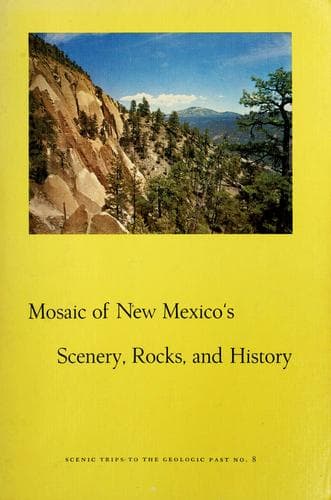
Mosaic of New Mexico's Scenery, Rocks, and History
History
Mosaic of New Mexico's Scenery, Rocks, and History
Geology -- New Mexico; New Mexico -- Description and travel; New Mexico -- History
But not for long, for at El Paso there gathered a force dedicated to
revenge for their comrades who had died before the Indian onslaught.
Ably led by Diego de Vargas, this expedition moved into New Mexico in
1692. The Indians, who had achieved such unity for the moment in 1680,
were again badly divided. De Vargas, instead of having to subdue an
alliance, had only to deal with one pueblo at a time. Very quickly New
Mexico was returned to a mission area and frontier military post. The
Pueblo Indians became permanently subjected to European domination.
Their one and only attempt at unity had, in the final analysis, failed.
During the seventeenth and eighteenth centuries, New Mexico was the
heart of the Spanish empire in the Southwest. Only in southwestern
Arizona, western Texas, and California did the Spanish hold any land
other than in the upper Rio Grande Valley of New Mexico. During these
centuries, this valley complex played out its dual role of mission area
and military outpost. Its only connection with the resources and ideas
of the world was a long hazardous road that stretched from Santa Fe to
Chihuahua City and then south to Mexico City. This was New Mexico’s
Royal Road, and over it moved everything needed by soldier, priest, and
civilian. The trade was dominated by the merchants of Chihuahua, and New
Mexico suffered. The tale of New Mexico during this period was one of
poverty, hardship, and warfare. And several vital forces moved across
the land.
One of these forces had long been in the Southwest, but latent. The
Spanish adopted an Indian word meaning _enemy_ to describe it—Apache!
The Spanish brought with them domesticated animals which quickly adapted
to conditions of the New World and became available to the Indian. Most
important was the horse, at least as far as the Apache was concerned. By
the early eighteenth century, the Apache, and other groups on the
plains, had adapted to the use of the horse. While dangerous as foot
soldiers, the Apache became vastly more dangerous as mounted warriors.
Whereas they had been satisfied with minor raids against the pueblos and
the Spanish holdings prior to 1700, they exploded on a wave of terrorism
during the eighteenth century which very nearly drove the Spanish from
the frontier. Late in the century, the conflict between the Apache and
the Spanish became increasingly bitter. The history of the Southwest
became the history of incessant Indian incursions and Spanish attempts
to control the raiders. The missions declined and in many instances gave
way entirely to the presidio or fort. In New Mexico the military came to
dominate the missionary, and only through the heroic efforts of the
meager force at the Presidio of Santa Fe did the Spanish manage to hold
New Mexico from total collapse. A poor province became poorer,
population declined, both among the Spanish and Indian, and the future
looked dark indeed.
Public-domain text, read in full here on John Shaqi.
Reviews
Reviews
No reviews yet
Be the first to share your thoughts on this work.
Join the Discussion
Join the discussion
Sign in to leave a comment or review.
Sign InorCreate an account