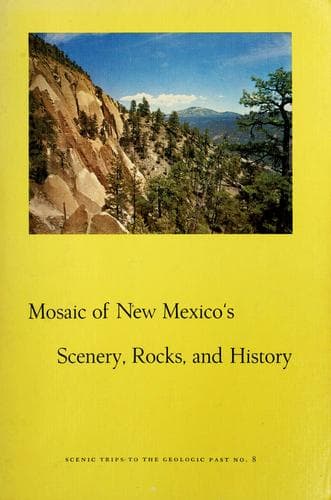
Mosaic of New Mexico's Scenery, Rocks, and History
History
Mosaic of New Mexico's Scenery, Rocks, and History
Geology -- New Mexico; New Mexico -- Description and travel; New Mexico -- History
The entire area north of Santa Fe, then, is alive with history. In every
village, in every canyon, there is something that will add to the
romance of Spanish-Indian New Mexico. In our Southwest, the heritage
handed down by these two great cultures is held dear by the people. To
the traveler will come a greater appreciation and a greater
understanding of New Mexico and the Southwest if these are but
understood.
Northeast New Mexico
The section designated as northeast New Mexico is an area of mountains
and plains, and its historical mosaic shows elements of both: the rugged
Sandia Mountains near Albuquerque and the southernmost parts of the
extensive Sangre de Cristo range, which thrusts north from U.S. Highway
85 far into Colorado, and part of the famed buffalo plains. The area is
drained by two main river systems; the Canadian River flows east to join
the Arkansas and the Mississippi and the Pecos River flows south to join
the Rio Grande.
Through this vast area ran one of Americas greatest highways, the Santa
Fe Trail. Beginning in Missouri communities, the Trail hurled itself
into the intricate patterns of the Great Plains with all of their
dangers—Indians, boredom, violent storms, treacherous rivers, and
prairie grass fires. Then on into the foothills of the mighty Rocky
Mountains and the steep and backbreaking approaches to Raton Pass in New
Mexico. The new highway across this pass (U.S. 85) and the nature of our
vehicles have made this an easy passage. But the traveler should pause
at some high point, or perhaps leave the main highway for a moment, and
try to imagine crossing this rugged land in Conestoga wagons. From
Raton, the Santa Fe Trail continued south to Las Vegas and thence into
Santa Fe via Glorieta Pass (current route of U.S. 85). Over this trail
passed the goods of the world. In part, these were intended for the
people of New Mexico, but over other trails they also found markets in
Mexico and in California. For the curious and adventurous, sections of
the Santa Fe Trail can still be seen. Local inquiry will elicit
directions to remaining parts of the wide rutted Trail, scene of so much
of the American westward movement.
[Illustration: (_Forest Service, U.S.D.A._)
How To see the Rio Grande Valley—from Sandia Crest]
While passing through the mountains between Santa Fe and Las Vegas, the
traveler should be aware that a critical Civil War battle was waged in
the fastness of these passes. In 1862, Confederate forces, which came up
the Rio Grande from Texas and won a series of victories over Union
troops, met a combined force of Colorado Volunteers and New Mexico Union
troops in a decisive contest over the control of the American Southwest.
The Union troops were successful, preserving New Mexico and the West for
the Union.
Public-domain text, read in full here on John Shaqi.
Reviews
Reviews
No reviews yet
Be the first to share your thoughts on this work.
Elsewhere in the archive
Join the Discussion
Join the discussion
Sign in to leave a comment or review.
Sign InorCreate an account