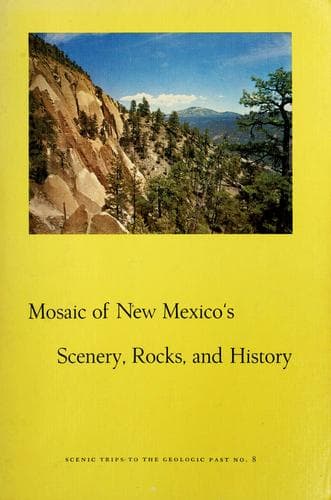
Mosaic of New Mexico's Scenery, Rocks, and History
History
Mosaic of New Mexico's Scenery, Rocks, and History
Geology -- New Mexico; New Mexico -- Description and travel; New Mexico -- History
These, then, are some of the things to look for in this region of plains
and mountains. Picture buffalo by the tens of thousands pushing up the
Canadian River, or long lines of wagons winding their way along the
Santa Fe Trail carrying goods and people into new lands, or the Blue and
the Gray locked in deadly combat far from the thunder of the main Civil
War battles. The mosaic here is sharp and vividly different.
Northwest New Mexico
Northwest New Mexico is typified as ancient Indian country. While
seemingly a harsh land, it is only this to the uninitiated, to those who
lock their minds to beauties of history and lands unlike their own. The
Indian found this country good and productive. Some of the finest ruins
of Indian antiquity are in this region—Chaco Canyon and Aztec, both
National Monuments, and hundreds more that remain unnamed. The Indians
of the Four Corners area (named thus because New Mexico, Colorado, Utah,
and Arizona meet here, the only place in the United States where the
lines of four states intersect) created levels of culture unsurpassed in
what is the continental United States; only the Indians of Mexico and
Peru claim a higher culture. This is a land whose ancient people reached
their great peak at the same time as the later Romans, as Charlemagne in
ancient Frankish Europe, and as Mohammed and his successors in the
Middle East.
But ancient Indians hold no monopoly on this vast region. Today many of
the Indians of New Mexico still find homes here. The Navajo Reservation
lies between Gallup and the Colorado line. Part of the Ute Reservation
lies along the northern edge of New Mexico, and the Jicarilla
Reservation is in the eastern part of this region. Many of the pueblo
people are found between Albuquerque and Santa Fe. At Gallup each year,
the famed Indian Ceremonials bring together peoples from many of the
tribes in the United States.
This region is also renowned as an oil and natural gas producer and is
one of the booming areas in New Mexico. But this is only one aspect of
the mineral riches of the northwest; the mines near Grants, between
Albuquerque and Gallup, produce tremendous quantities of uranium ores.
The atomic energy capability of the United States begins at Grants. And
near Gallup and Fruitland are huge open-pit coal mines.
The northwest is drained by the San Juan River, a tributary of the
Colorado River, and is therefore a part of the Pacific watershed. The
Navajo Dam project, just east of Farmington, is a part of this drainage
pattern.
Thus the region is characterized by Indians old and new, ancient things
buried deep beneath the earth, and great beauty in pastel colors and
subtle contrasts—the mosaic of the land.
East-Central New Mexico
Public-domain text, read in full here on John Shaqi.
Reviews
Reviews
No reviews yet
Be the first to share your thoughts on this work.
Elsewhere in the archive
Join the Discussion
Join the discussion
Sign in to leave a comment or review.
Sign InorCreate an account