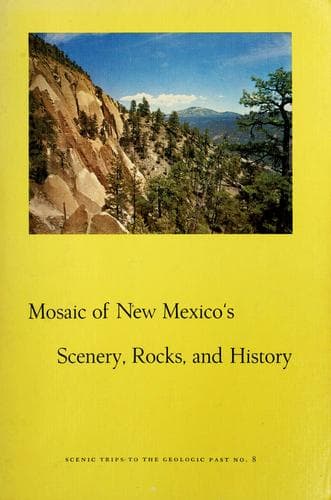
Mosaic of New Mexico's Scenery, Rocks, and History
History
Mosaic of New Mexico's Scenery, Rocks, and History
Geology -- New Mexico; New Mexico -- Description and travel; New Mexico -- History
[Illustration: (_Courtesy Elliott S. Barker_)
Ghost Ranch Mountain north of Abiquiu]
Derricks and Mines
_by_ George B. Griswold
New Mexico is a mineral-rich state. The gross production value of oil,
gas, and minerals was $671 million during 1963, making the state the
sixth ranking mineral producer in the nation. New Mexico ranks among
other states as follows: first in the production of potash, uranium,
perlite, and carbon dioxide; third in helium; fourth in copper; fifth in
natural gas and liquids; and seventh in petroleum. Important amounts of
zinc, lead, gold, silver, magnesium compounds, coal, gypsum, pumice, and
salt are also produced from deposits within New Mexico. The oil and gas
industry holds a dominant position in the state, accounting for almost
two thirds of the value of minerals produced.
OIL AND GAS
Most of New Mexico’s oil and gas are produced in the southeastern part,
south and east of Roswell. The bustling towns of Hobbs, Artesia, and
Lovington, as well as Roswell, are headquarters for the many oil
companies and the associated service and supply organizations operating
in the area. Oil and gas are produced from numerous reservoirs, called
_fields_ or _pools_, in Paleozoic sediments ranging from Ordovician to
Permian in age. From the standpoint of production, the Eunice-Monument
field (lying between these two towns) is the largest, having produced
more than 250 million barrels of oil. Other important fields are Hobbs,
Vacuum, Langlie Mattix, Denton, and Jalmat. All these fields produce a
considerable amount of gas associated directly with the oil.
When driving an automobile through southeast New Mexico, a layman finds
it difficult to comprehend the immensity of the petroleum industry of
that region. This is due to the scattering of wells over a large area.
Seldom are wells spaced closer than one to every ten acres, even in the
most productive fields. There are, in fact, some 16,000 wells in this
part of New Mexico, ranging in depth from less than 1000 feet to 17,555
feet.
The other oil- and gas-producing area of the state is in the northwest,
in the San Juan Basin. Farmington serves as the base of operations for
most of this activity. In 1962, there were 7378 wells in the area, 1770
of which were producing oil and gas and 5608 producing gas only. Most of
the San Juan Basin production is from Cretaceous sandstones, in contrast
to the southeast where the oil and gas are derived from Paleozoic
sediments. The development of the San Juan Basin production is
relatively new; most of the wells have been drilled since World War II.
The petroleum industry can be proud of the great help it has given to
the development of this once-almost-forgotten part of the state.
[Illustration: (_Courtesy El Paso Natural Gas Co._)
There’s the way to refine oil! Look at those mesas, near Gallup]
Public-domain text, read in full here on John Shaqi.
Reviews
Reviews
No reviews yet
Be the first to share your thoughts on this work.
Elsewhere in the archive
Join the Discussion
Join the discussion
Sign in to leave a comment or review.
Sign InorCreate an account