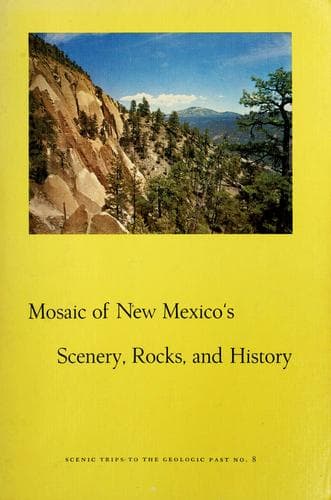
Mosaic of New Mexico's Scenery, Rocks, and History
History
Mosaic of New Mexico's Scenery, Rocks, and History
Geology -- New Mexico; New Mexico -- Description and travel; New Mexico -- History
The methods of finding and producing oil and gas have come a long way
from the “boom town” days when wells were drilled for the most part on
pure hunches and hopes. The exploration and exploitation of petroleum
are now highly specialized technologies. All branches of the geologic
and geophysical sciences are brought into play to piece together a
comprehensive picture of all the factors which may have made a certain
area favorable for the accumulation of oil or gas. These factors include
such things as the age, thickness, and permeability of the sedimentary
rocks, the structure, old shorelines, and buried reefs. Once a target is
selected, a drilling rig is moved onto the location to prove or disprove
the theory. This is the costly step of finding oil. A single 10,000-foot
hole may cost $350,000, and some individual wells in New Mexico have
cost more than $1 million to drill. If the well is in a completely
untested area, it is called a “wildcat.” Once a discovery is made, then
the land around the wildcat is explored by “offset” wells until the
complete extent of the new field is proved.
During 1962, 1666 wells were drilled to an average depth of 5153 feet.
The average drilling cost was $71,000 a well, representing a total
investment of almost $120 million in a single year! Most of these wells
were of the development (offset) type, but even then, 27 per cent were
dry. During 1962, 295 true wildcats were drilled; of these, only 46
found oil or gas—about two out of every thirteen.
The story of oil just begins with the discovery of a well. Various
special “completion” operations are applied to the oil-producing horizon
so as to increase the flow into the well. The most common techniques are
either by “acidizing,” pumping acid into the formation to increase flow
by enlarging the pores in the rock, or by “hydrafracing,” whereby actual
cracks are induced in the formation by pumping oil from the surface back
into the well under very high pressure. After the well is “completed,”
it may be a natural-flowing well if sufficient gas is associated with
the oil. If sufficient gas is not present, then the well is pumped.
In recent years, considerable success has been achieved in revitalizing
old fields where production had dropped below the point of economic
operation. These fields are reactivated by forcing either water or gas
down selected wells within the field, thereby forcing stagnated oil
within the producing zone toward the other wells. This technique is
called _secondary recovery_. Many fields will produce more oil under the
secondary recovery program than they did during their primary life.
[Illustration: Here’s a wildcat for you!]
Public-domain text, read in full here on John Shaqi.
Reviews
Reviews
No reviews yet
Be the first to share your thoughts on this work.
Elsewhere in the archive
Join the Discussion
Join the discussion
Sign in to leave a comment or review.
Sign InorCreate an account